Posted on

Equisetum telmateia

A Horsetail for the ages.

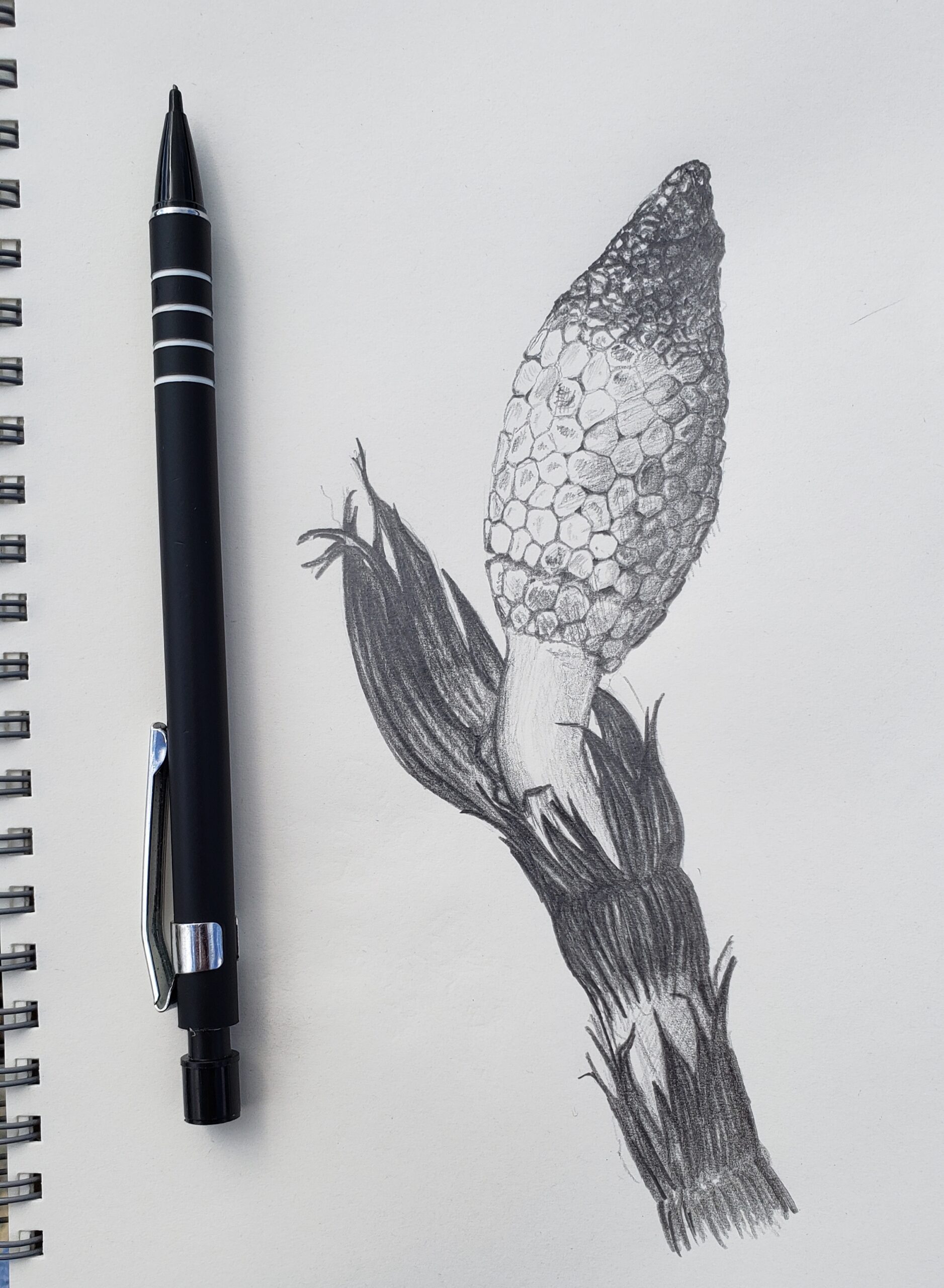
This is Equisetum telmateia. Or more accurately, this is a late spring, newly emerge fertile stem of the Equisetum telmateia. Its a herbaceous perennial, native to British Columbia, and I found this one growing on the side of Burnaby Mountain.

I remember my dad telling me all about this species as a kid. We use to see a lot of it growing around the edge of Magic Lake on Pender Island where my grandparents lived. It was a neat little plant you could pull apart and put back together like a puzzle.

It’s pale yellowish, non-photosynthetic, spore-bearing, fertile stem only lasts a short while before dying right back and being taken over by the more familiar green, herbaceous, photosynthetic, sterile stems.

At the top of the stem is the cone-like, reproductive portion of the plant, called the strobilus. It is comprised of row upon row of hexagonal spore-bearing structures. Each little hexagon produces thousands of tiny spores.

When released, a spore will start to grow into a new plant, which is either bisexual or male. Sperm are produced by the new plants, complete with tiny flagella, and swim through the water in search of female plants. Once fertilized, the plant will grow to maturity, starting the cycle over again.

Having existed since the Devonian era in the great Carboniferous period, horsetails are true living fossils. There are only about twenty species of horsetail in the world, all in one group, or genus, known as Equisetum. Ten species are found in British Columbia, and six of these exist on Vancouver Island and in the Lower Mainland.

Horsetails are a part of a unique group of plants, halfway between primitive plants like mosses, and more highly evolved flowering seed plants (angiosperms and gymnosperms). Horsetails produce spores, like ferns and mosses, not seeds. Yet Horsetails have specialized vascular tissues for conducting water, food and minerals through the stem, unlike the more primitive bryophytes or so-called ‘lower vascular’ plants.

400 million years ago saw the planet dominated by these lower vascular plants, which at the time included species that grew as tall as buildings. In fact forests existed for so long, and grew so large, their remains provide the bulk of the world’s coal beds.

As for any beneficial uses, sorry folks, despite centuries of use in traditional medicine, there is no evidence that Equisetum has any medicinal properties.

However the stems are coated with abrasive silicates, making them useful for scouring (cleaning) metal items such as cooking pots or drinking mugs, particularly those made of tin. Equisetum hyemale, rough horsetail, is still boiled and then dried in Japan to be used for the final polishing process on woodcraft to produce a smoother finish than any sandpaper.

– Aaron

Posted on

Oniscus asellus vs. Armadillidium vulgare

Is it a Sowbug or a Pillbug?

A lot of the species we come into contact with on a regular basis at home, in the garden, or out out for a walk, are introduced species. Some become invasive and make headlines, causing obvious and recognizable damage to the environment. While other species quietly do their thing, making themselves right at home in their new environs, blissfully unnoticed.

Take the wood louse, er.. sowbug.. pillbug.. no no, roly-poly. See, this is when binomial scientific names comes in handy. It seems every locale has their own common name for these critters. This however is dually confusing because we are in fact dealing with TWO surprisingly different animals. So let’s clear this up.

Sowbugs, Oniscus asellus (oniscus from ancient Greek for small donkey) and Pillbugs, Armadillidium vulgare (you guessed it, armadillo-like. Vulgare means common). Both were inadvertently introduced to the New World from Europe, probably on trans-atlantic ships, several hundred years ago. Sowbugs and pillbugs are similar in appearance and their common names are sometimes used interchangeably.

*The three photos above of Armadillidium vulgare were taken from the web. I know I have some great photos of pillbugs, somewhere.. but I can’t seem to find them.

Both are terrestrial, soil-dwelling crustaceans that belong to the order Isopoda. They are the only crustaceans that have adapted to live a completely terrestrial life. However, just like their cousins.. shrimp, crab, lobster and crayfish.. they have gills which need constant moisture, so they tend to live in moister northwest climates.

The sowbug has a pair of tail-like projections which extend from the rear of its body, while the pillbug does not have any extreme posterior appendages. The pillbug can roll up into a tight ball when disturbed, whereas the sowbug can sort of fold itself in half, kinda. This is why pillbugs are sometimes called “Roly-Poly” bugs.

They do not bite, sting or transmit disease. They are harmless to humans. They primarily feed on decaying organic matter, but sometimes nibble on things in the veggie garden. Like all crustaceans, they go through a molt 4 to 5 times during an average lifespan of 3 years.

So now you know. Tell a friend. Pick one up and take a closer look next time you run across one of these terrestrial isopods.

– Aaron

Posted on

Lichens

Those who lichen.. lichen a lot.

So lichens are cool. I mean, what’s NOT to lichen? Composite organisms consisting of both a fungus and a simple photosynthesizing organism like algae or cyanobacteria. Up close, lichens reveal an amazing array of colour and tiny networks.. daunting if your plan is to try and draw the darn thing.

But I’m a sucker for patterns.. especially naturally occurring ones. Lichens are just that! Big ol mess of repeatin patterns. And I’ll admit, this is probably the one organism that I just couldn’t (still haven’t) fully wrapped my head around. Soooo much fine detail!

As a subject of study and appreciation lichens, no matter the type, really try and draw you in to their labyrinth of detail. I start to feel this obligation to share EXACTLY what I’m seeing in person. This is when I remind myself, that this is why the photograph was invented.

But as abstract inspiration, the possibilities seem endless. So I guess, here is a first look at a few of my attempts at capturing the lichen world.. and I might as well toss some learnin out there too.

As in all my posts, I take all my own photos with my trusty Samsung Galaxy S9 (cutting edge technology folks).. no editing, just some cropping. All of these lichens were observed within a 15 minute radius of my house in Burnaby, British Columbia, with the exception of the two photographs below. The yellow crustose lichen was found on a south-facing rock at the peak of Whistler Mountain, and the grey crustose lichen was found growing at Lighthouse Park in West Vancouver.

Lichens are grouped into three main types:

  • Foliose – which have a leaf-like appearance.
  • Fruticose – are highly branched, either hanging or standing up.
  • Crustose – are the ones that look like a crust that has formed on a surface like a rock or tree trunk.

The algal (or bacterial) component is the autotroph in this relationship. It supplies the nutrients to the organism through photosynthesis. The fungus protects the algae from desiccation and also provides it with a means to grow and attach to whatever substrate.

..and if you enjoy being bombarded by Latin and scientific terminology, do yourself a huge favor and look up lichen taxonomic classification or Lichen Growth forms and internal structures. Good times my geeky friends!

They are slooooooow growing and everywhere. It is estimated that 6% of Earth’s land surface is covered by lichens. And they are not a picky lot either. Some lichens were exposed to Martian atmospheric conditions in the lab for a period of over 3 weeks in 2012.  Despite the weak atmospheric pressure, lack of protection from cosmic radiation, bitter cold and alien atmospheric composition, some species not only survived, but continued to grow and function with relative normality! Lichens can even grow on plastic.

Hummingbirds and other nest building species use lichen for nest building and camouflage. Lichens can even be used in making dyes and perfumes, as well as traditional medicines.

Lichens are eaten by many different cultures as well, though its generally when times are lean. Lichens are not very easy to digest and contains minimal nutritional content. And of course, a few lichen species are eaten by insects and larger animals such as reindeer. Remember kids, no reindeer, no Christmas!

So love a lichen! A delicate, yet resilient organism that’s been practicing unchecked socialist behavior in our forests, across our tundra, and on the sides of volcanoes since the beginning of time (or at least since the devonian). Living in mutually beneficial, symbiotic, cross-species, relationships. Buncha single-celled hippies.. chillin, sharin.

– Aaron

Posted on

Sinodendron rugosum

The Rugose Stag Beetle

They say a picture is worth a thousand words, but when it comes to learning about biology, binomial nomenclature is where it’s at. Scientific names can tell you so much about an organism. Take Sinodendron for example.. sino for nose, and dendron for the Greek work for tree or branch-like. The species name rugosum, is Latin for ‘full of wrinkles, folds, and creases.

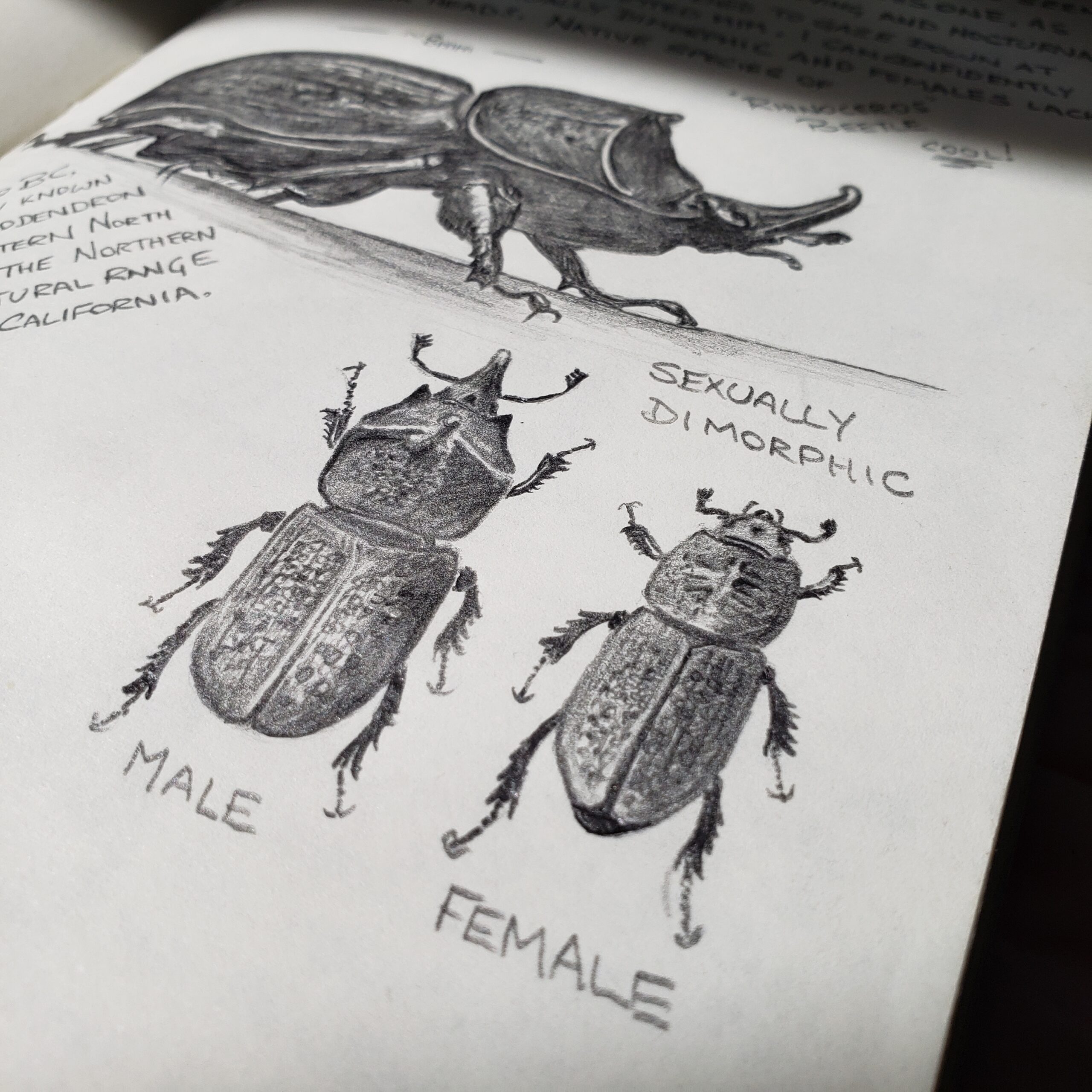
So there you have it. We’re off to a really good start. It is an organism that has a thing on its nose and it’s got wrinkles.. and sure enough, Sinodendron rugosum, sometimes called the rhinoceros beetle, has a horn on it’s nose and a rugose carapace. They are more accurately called Rugose Stag Beetles because the mandibles on the male, which may be as long as the body, are branched and bear a resemblance to the antlers of a stag. However, upon closer inspection, I think this little guy more closely resembles teenie tiny triceratops.

I always grew up thinking rhinoceros beetles were relegated to Europe, with a few of their exotic cousins residing in the jungles of Central America or Africa. Not so.. they are found on every continent except Antarctica.. and this species is in fact a native to British Columbia. He is the first of his species I’ve ever come across, so I’ll try and keep my excitement in check.

I found this little guyon a walk in early July of last year. It was around 7:00pm when I spotted him crawling under a piece of bark on a large fallen alder trunk in the woods near my home. At only 8mm in length, it first looked to be just another common LLB (little brown beetle).. until it caught the light! It turns out that the rugose carapace it’s sporting is also incredibly shiny, almost metallic. The small undulations on its back twinkle like tiny, jet-black jewels.

Like all Stag Beetles, members of family Lucanidae are highly sexually dimorphic. Males feature enlarged head modifications while females, usually smaller in size, do not. Despite its slow speed, S. rugosum is very strong for its size. Like all Stag beetles species, it seems to defy normal physics with its ability to grab on and hold tight with its clawed legs. This comes in handy when males fight eachother in the presence of females.

They are primarily nocturnal and feed on plant matter (alder, birch, maple, oak trees). Females will lay eggs on tree bark and in short order, tiny crescent-shaped, white larvae hatch and begin to tunnel inward, creating pupal chambers. This ultimately damages the tree, buy hey.. they’re soo cute! Who’s a cute little triceratops? Yes, you are..

– Aaron

Posted on

Tabula villa mea

A map of my home town

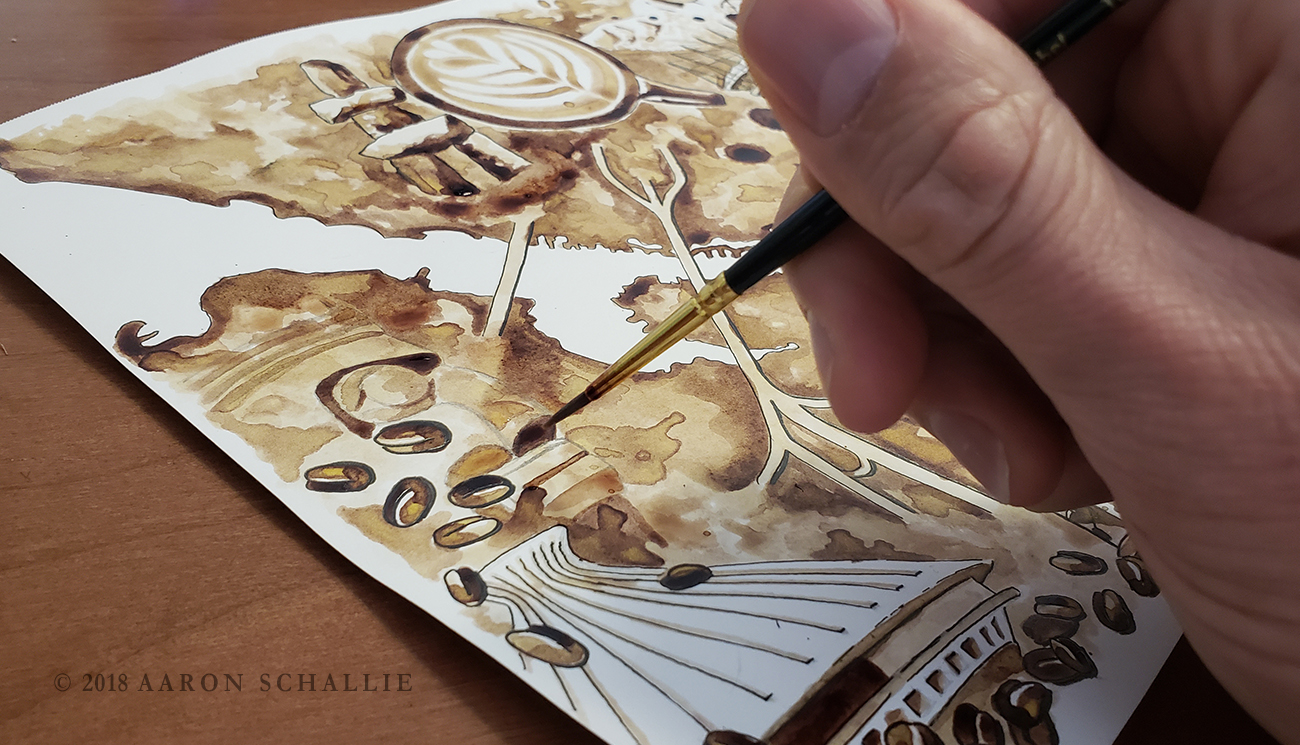
Here’s a fun piece I did back in 2018 of an artistic map of Vancouver’s False Creek seawall. I really enjoyed playing around with ink for the first time. I was hoping to create a spilled-coffee look and I think I found it. Watered down, slowly building up layer upon layer, Winsor and Newton’s Peat Brown Ink did the trick.

Seldom am I found not holding a coffee when I’m out trekking around the city or sitting and drawing on a trail somewhere, so coffee was definitely my inspiration. I’ve even tried painting with coffee.. with some success. The problem with coffee is when it dries, the layers of coffee wipe away unless you spray fixatif or something to seal it. This unfortunately makes things messy and start to run, so I’m glad I found an ink solution.

I was already well into this piece when I happened to come across a Facebook post from Spacing.ca Magazine. Based in Toronto, Spacing is a magazine and website that covers urbanist topics including art, culture, transit, city planning and governance, to name a few. The post was an announcement of their annual Creative Mapping contest and they were looking for artists to submit original creative maps inspired by a Canadian city. The deadline was fast approaching, but I figured I could finish in time.

The painting consists of a map of the False Creek seawall and all three bridges that cross it into downtown. From left to right they are; the Burrard Street Bridge; the Granville Street Bridge; and the Cambie Street Bridge.

Around the painting I included a few of my favourite pieces of public art and iconic buildings in the area. Starting at the top, a latte from any number of the overpriced Yaletown beaneries. To its left, the Inukshuk that stands at Sunset Beach and was the inspiration for Vancouver’s 2010 Winter Olympics logo.

To the right of the latte, stand the majestic North Shore mountains and the Lions peaks. Below that, BC Place Stadium, home of the Vancouver Whitecaps FC and the BC Lions Football team, with its new retractable roof. To the right of the mountains, container cranes at the Port of Vancouver, visible from this part of town, as they tower over Chinatown and Vancouver’s Strathcona neighbourhood.

Below the cranes is the Telus World of Science, a geodesic dome built in time for Expo 86 and home to Vancouver’s own Science World ever since. Below that, more coffee porn in a to-go cup.

The next image is of an Aquabus, one of the many tiny passenger ferries that ply the sheltered waters of False Creek. Standing tall next to the bridge on Granville Island, GIANTS at the Ocean Concrete worksite. Brazilian street artists Os Gemeos were commissioned to paint these monoliths for Vancouver’s 2014 Biennale exhibition.

On the left side of the painting, in the Kits Point neighbourhood, I included the H.R. MacMillan Planetarium. A beautiful building housing the Museum of Vancouver and the space centre. It opened it’s doors to the public in 1968 and was made to resemble a traditional Haida cedar-woven hat.

Finally, the totem pole that stood at the foot of Cypress Street in front of the Vancouver Maritime Museum at Hayden Park. The pole was carved by Mungo Martin with his son David and nephew Henry Hunt to mark the province’s colonial history. Oh yeah, and I framed it all with some coffee beans.

It took me a little over a week to complete.. and yes, my painting was published in the Summer 2018 issue ????

– Aaron

Posted on

Pentidotea wosnesenskii

Exploring Saysutshun on Newcastle Island and getting reacquainted with the Pickle Bug.

Just got back from our first mini-trip since the pandemic hit. A few days in Nanaimo, British Columbia to visit family and a day to explore Saysutshun (Newcastle Island Marine Provincial Park). The island is just a short foot-passenger ferry ride across the harbour from downtown. It was a nice warm, overcast day to pack a picnic and spend some time exploring the intertidal zone during a perfectly timed low tide.

Beautiful little ecosystems, teeming with invertebrate marine life and many species of algae, ring this protected marine park. Almost 30 hectares of this 360 hectare island is easily accessible foreshore. You don’t have to walk far from where the ferry drops you off to start exploring and discovering some pretty funky wildlife.

..and if you head down to the intertidal and flip-over a rock* or find a patch of Pacifc Rockweed (Fucus distichus) riffraff, you’re sure to come across one of these little guys chillin, waiting for the tide to come back in. The Rockweed Isopod, Pentidotea wonsnesenskii.

*Please remember to return any rocks you flip over to as close to its original position as possible.. many of the organisms in these small communities are slow moving and very slow growing. If different areas of the rock are left exposed, sedentary species may have to start growing from scratch, become easier prey or even die. Leave it like you found it.

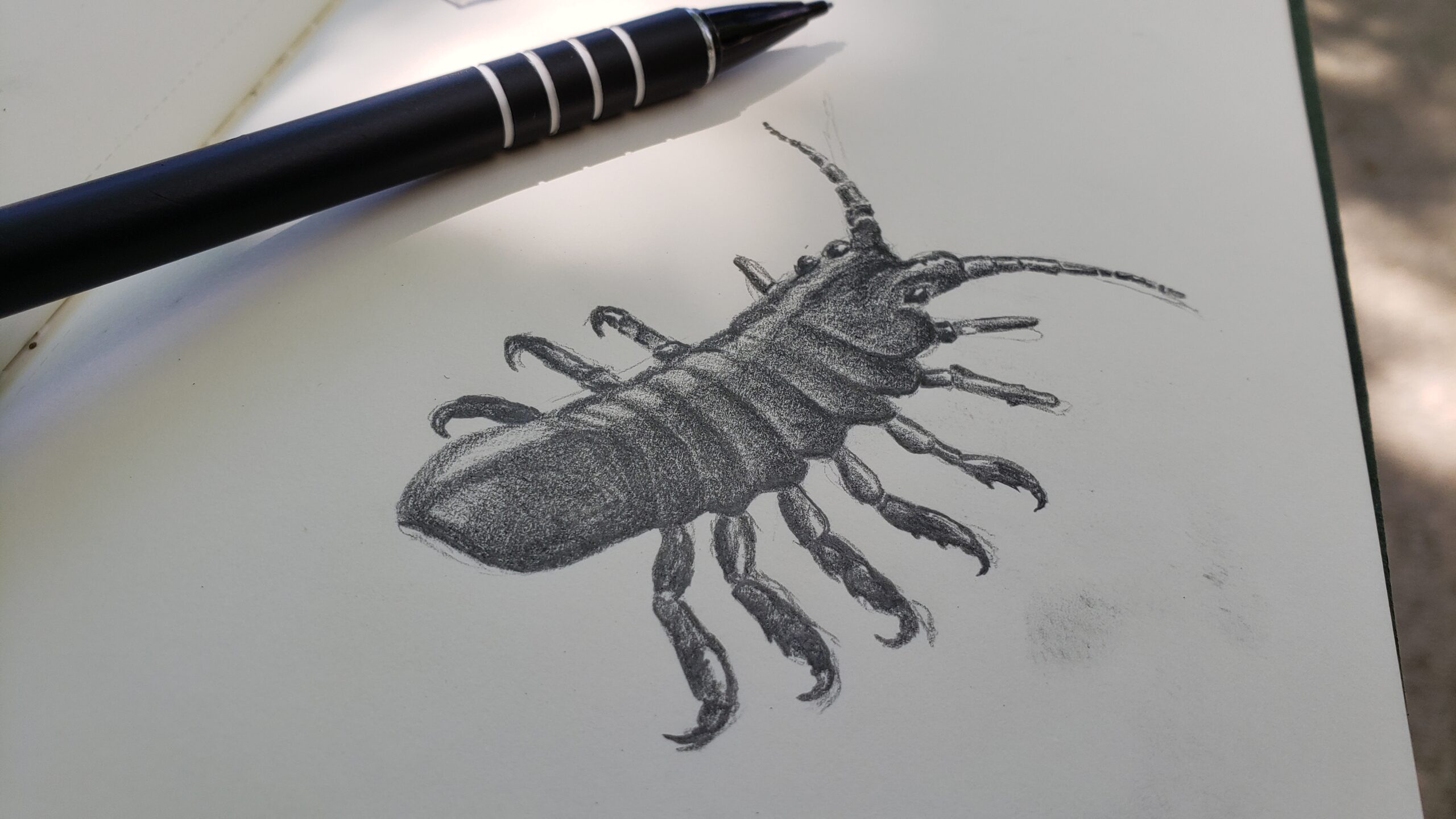
Usually found clinging to its namesake algal species, trying to keep cool and not dry out during the low tide, the Rockweed Isopod is a harmless, prehistoric looking, non-decapod crustacean. It has seven pairs of very strong legs, perfectly suited to hang on to just about anything, despite living in a habitat prone to strong currents and and extreme exposure.

It is known by a few other names.. Vosnesensky’s isopod, Kelp isopod, Olive-green isopod, Green isopod and the Pickle bug. They are typically an olive-green colour, but can also be tan, brown, yellow, black or pink.

Their colour depends upon the type of algae that they are associated with. Their body colour can change with time, but scientists do not yet understand how this happens; but, it is not related to their diet.

Back home, in Vancouver’s English Bay, rockweed isopods are a little harder to come by. My favourite spot to sit and draw, near the foot of Dunbar on Point Grey Road, has a few. The local colouration, seems to be dark brown to jet-black and back in 2019, I had a chance to sketch the subject.

As you can see, I didn’t quite finish it. I was planning to fill it up and add some more info.. but honestly, I had forgotten all about this drawing. Thankfully, my recent trip reminded me, and maybe I’ll take another crack at sketching this neat little marine invert again soon.

– Aaron

Posted on

Acer circinatum

Going out on a limb here.. No, no.. Branching out.. No wait, “Don’t Stop Be leafing” ..yeah, that one.

(TREE PUNS)

Much like myself, the Vine Maple is from Western North America and is usually found within 300 km of the Pacific Ocean. Good choice.

Another awesome local species, Acer circinatum features bright green and chartreuse branches, white flowers with deep-red sepals, and brightly coloured red and green, winged fruit. It has symmetrical, almost round, palmate leaves that turn from green to golden yellow in the fall. Typically, each leaf has 7 to 9 lobes.. lots of interesting lines, shapes and colours to consider when setting out to capture an artistic likeness of this specimen.

One of the most recognizable characteristics of the Vine maple tree is its penchant to twist, bend and droop. Branches regularly grow horizontally, often changing direction and sometimes bending right over, coming into contact with the ground. This can cause the top of the tree to grow a new root system, creating natural archways. This characteristic makes it the only maple capable of layering, adding a uniquely West Coast flair to out wooded areas.

A few stunningly complex tangles come to mind locally in; Stanley Park, especially along the trails near Beaver Pond; Tynehead Regional Park in Surrey; Campbell Valley and along the Fort-to-Fort Trail in Langley; Mundy Park in Coquitlam; Deer Lake Park in Burnaby; and Buntzen Lake in Anmore, to name a few. All have beautiful examples of established (probably second- or third-growth by now) Vine maple specimens, 30-40+ years old and highly visible from the many walking paths and trails.

I didn’t really have anything specific in mind at first. I had just returned from a walk and had taken a few pictures of some rain soaked Vine maple branches along the way. It was early February and there were few living leaves to be found in the woods. With no foliage to obstruct my view, theses branches stood out against the browned and mostly dormant forest, like over-sized stalks of fresh asparagus.

Their colour stayed with me the entirety of my walk back and I tried my beginners best to replicate it in watercolor when I got home. I started with the branches and decided to add the fruit and flowers next. I really think I need to work on my color mixing, but overall I’m happy with it. I’m still a bit reluctant to add text. I think it needs it, but I’ll probably come back to it one day with a bit more purpose.

– Aaron

Posted on

Populus trichocarpa

The Black Cottonwood – Salicales Salicaceae Populus trichocarpa if you wanna get picky.

So here’s a sketch I did of some black cottonwood branches in early Spring of this year. It’s a subject I come back to time and again. Leaves are few and far between in early February, so I thought I’d tackle some of the otherwise hidden textures present on the gnarly leftovers from last season. Cottonwood has such character and always has something to offer when I’m itching to sketch and stuck for ideas.

Love em or hate em, I think here in the Lower Mainland of BC, almost everyone has a relationship with the cottonwood. This local tree evokes all kinds of emotion in people, for different reasons, at different times if the year. Every season seems to offer a number of reasons to hate and enjoy this local monster.

Like when it’s allergy season. I count myself as one of the lucky ones who get to enjoy the sweet fragrance of their sticky buds on long walks this time of year.. while others need to remember their daily, 24 hour, fast-acting, non-drowsy antihistamine or suffer the litany of symptoms we all know so well from the seasonal pharma-jingles on the radio, television and such.

Or later in the year when its fluff season. Making it appear to snow in June, the fluffy seeds accumulate into large drifts, becoming knee deep for weeks on end where I live. Every year, big gobs of fuzz inevitably sneak their way into the house and collect in the most hard to reach places. But outside, like in Burnaby’s numerous wetland and repirian habitats, the air can erupt in a beautiful storm of unseasonably flurry-like conditions with the softest of breezes.. and you don’t have to worry, most people are allergic to the pollen not the fluff, so dive in!

Or is it when the winds pickup in early fall. The air starts to cool and the large egg-shaped leaves, almost as wide as they are long and beautifully coloured, litter the paths and sidewalks. That time of year when you get to throw on a light jacket and maybe a scarf for the first time since last year. The breeze starts to blow and you notice how loud the dried leave are rustling high up.. and then you look back down and discover your car’s windshield has been destroyed by a fallen branch as thick as your leg. You know, that branch you park under everyday on the street outside, failing to notice its precarious growth and precise targeting.

Maybe it’s the critters? The Black Cottonwood is the ‘live fast, and die young’ poster child of our local deciduous tree species and do not live very long. However, they grow very quickly and they grow huge. It is one of the few trees big enough to hold bald eagle nests. When branches break off, large open cavities are created high up in the canopy.. perfect nesting sites for any number of owl and woodpecker species, raccoon, squirrel, etc. A sure favourite of numerous species including invertebrates, plants, and eventually fungi and bacteria.

And at ground level and below, the cottonwood’s aggressive and uncontrollable growth can sometimes be costly to home owners. Branches shed regularly and cause damage to roofs and gutters. Roots can destroy sidewalks, driveways, plumbing and drainage. And they are pretty indestructible. In fact the shoots and roots contain so much rooting hormone, even a small piece of fallen branch can root and become a clone. They survive most major weather damage and even a clear-cut at ground level won’t kill this survivor.

Indeed there are plenty of grounds for disappointment and anger in the case against the the Black Cottonwood. But it does play an important role in our local environment, as well as in our homes. In fact, if you happen to be using Scotties toilet paper here in BC, it probably came from cottonwood pulp grown in Chilliwack and made in New Westminister. So there’s that. Maybe not such a pain in the ass after all.

Watercolor paintings were done on De Serres Aquarelle 300 gsm coldpress watercolour paper by Fabriano. I can’t remember the exact colours I used in my ‘soup’ of paint, but they are most definitely Windsor & Newton Professional watercolour and possibly some raw sienna by PWC Premium Extra Fine watercolour. I tried a stylized approach to painting the branch above. I like how it turned out.

For the pencil sketches, I used the same mechanical pencil I use for most of my drawing in the field. I found it in the car under the passenger seat, so who knows where it came from. It’s loaded with .07mm HB lead. I’m drawing in one of my Moleskine 13 x 21cm plain paper Cahier Journal. I absolutely love the paper’s smooth finish.

Couple Extras:

I think that hormone thing is pretty interesting. I have heard there is enough hormone present, that an extract of the shoots can be used as a rooting hormone for all types of cuttings. Shoots are gathered, chopped and soaked in cold water for a day to create the solution.

I also know, from the horrible stains they can leave on your patio and concrete, that a yellow dye can be obtained from the leaf buds. I have made walnut ink before.. I’ll have to try this next year sometime.

It’s also cool to note that on older trees, the bark becomes fissured, gnarly, thick, and very hard.. hard enough to cause sparks when being cut by a chainsaw.

– Aaron

Posted on

Oemleria cerasiformis

‘Oso’berry, from the Spanish word for bear + berry.

The most widely used common name for this local is ‘Indian Plum’. A dated name to say the least. It is also sometimes referred to as a June Plum, Oregon Plum (inaccurately), Squaw berry (cringe), Osmaronia (plant nurseries), and Osoberry (from the Spanish word for bear).

So Osoberry it is..

It’s a native to the Pacific Northwest, from British Columbia, Canada to Santa Barbara County in California.. but you can read all about that kind of stuff on wikipedia. What I can tell you is why I chose to draw it and why I think it’s a special yet underappreciated local shrub.

Osoberry is usually the first sign of fresh life and new colour in our local wooded areas. A barometer of the coming change to Spring. A real ‘pick-me-up’ following our long, wet Vancouver winters. Early to bud and quick to bloom (mid-February), Osoberry ushers in the early Spring by lining paths and dutifully filling in the undergrowth, first with sprays of small white clustered flowers, followed in short order by large chartreuse, elliptical leaves. It always gets me looking forward to setting up the garden and Easter.

The flowers are one of the very first sources of nectar for pollinators and hummingbirds in the new year, and the berries that start to appear in early June are an important food sources for countless birds and mammals. Each berry cluster (female plants only) consists of a half dozen or more fruit resembling tiny plums, containing a hard pit and very tart flesh. I love how the fruit in each cluster tend to ripen at different times, offering a short-lived, tricolor rainbow display. Definitely something I would like to try and represent with some watercolour in the future.

The flowers.. can have a very strong scent of cat-urine if cut and taken indoors.. but on the trail, take a leaf and crush it in your hand to reveal a pleasant smell of cucumber. If your looking for birds.. vireos, kinglets, finches, junkos, hummingbirds and warblers, to name a few.. this is a good place to start. Of course, if you happen to be in the right area.. usually in the evening, you may also be lucky enough to see bears feeding on the fruit, as the name suggests. Sometimes, they leave behind a gift.. evidence of their last meal, filled with seeds ready to germinate. As I write this post, I am sitting not 10 meters away from this morning’s bear dung donation behind our house.

And when it’s all over, the Osoberry’s parting gift of seasonal colour is the change from green to cheerful yellow leaves. Splashes of yellow highlights begin to appear in July, accelerating in August before they detach and fall to the ground, eventually filling the forest floor and creating golden trails and pathways through the thinning under brush.

So now, I’m going to assume you know which shrub I’m talking about. Osoberry has always been a favourite of mine, as it offers so many opportunities and inspiration for creation and study, throughout the year.

For this sketch I chose a simple mechanical pencil, loaded with .07mm HB lead. I’m drawing on my cherished Christmas 2018 gift sketchbook from my creative buddy Caitlin. She got it from MUJI on Robson and customized the cover for me. The paper is plain white, probably 15lb pages, with smooth finish.

I drew this back on April 4th, 2019.

– Aaron