Posted on

Oniscus asellus vs. Armadillidium vulgare

Is it a Sowbug or a Pillbug?

A lot of the species we come into contact with on a regular basis at home, in the garden, or out out for a walk, are introduced species. Some become invasive and make headlines, causing obvious and recognizable damage to the environment. While other species quietly do their thing, making themselves right at home in their new environs, blissfully unnoticed.

Take the wood louse, er.. sowbug.. pillbug.. no no, roly-poly. See, this is when binomial scientific names comes in handy. It seems every locale has their own common name for these critters. This however is dually confusing because we are in fact dealing with TWO surprisingly different animals. So let’s clear this up.

Sowbugs, Oniscus asellus (oniscus from ancient Greek for small donkey) and Pillbugs, Armadillidium vulgare (you guessed it, armadillo-like. Vulgare means common). Both were inadvertently introduced to the New World from Europe, probably on trans-atlantic ships, several hundred years ago. Sowbugs and pillbugs are similar in appearance and their common names are sometimes used interchangeably.

*The three photos above of Armadillidium vulgare were taken from the web. I know I have some great photos of pillbugs, somewhere.. but I can’t seem to find them.

Both are terrestrial, soil-dwelling crustaceans that belong to the order Isopoda. They are the only crustaceans that have adapted to live a completely terrestrial life. However, just like their cousins.. shrimp, crab, lobster and crayfish.. they have gills which need constant moisture, so they tend to live in moister northwest climates.

The sowbug has a pair of tail-like projections which extend from the rear of its body, while the pillbug does not have any extreme posterior appendages. The pillbug can roll up into a tight ball when disturbed, whereas the sowbug can sort of fold itself in half, kinda. This is why pillbugs are sometimes called “Roly-Poly” bugs.

They do not bite, sting or transmit disease. They are harmless to humans. They primarily feed on decaying organic matter, but sometimes nibble on things in the veggie garden. Like all crustaceans, they go through a molt 4 to 5 times during an average lifespan of 3 years.

So now you know. Tell a friend. Pick one up and take a closer look next time you run across one of these terrestrial isopods.

– Aaron

Posted on

Lichens

Those who lichen.. lichen a lot.

So lichens are cool. I mean, what’s NOT to lichen? Composite organisms consisting of both a fungus and a simple photosynthesizing organism like algae or cyanobacteria. Up close, lichens reveal an amazing array of colour and tiny networks.. daunting if your plan is to try and draw the darn thing.

But I’m a sucker for patterns.. especially naturally occurring ones. Lichens are just that! Big ol mess of repeatin patterns. And I’ll admit, this is probably the one organism that I just couldn’t (still haven’t) fully wrapped my head around. Soooo much fine detail!

As a subject of study and appreciation lichens, no matter the type, really try and draw you in to their labyrinth of detail. I start to feel this obligation to share EXACTLY what I’m seeing in person. This is when I remind myself, that this is why the photograph was invented.

But as abstract inspiration, the possibilities seem endless. So I guess, here is a first look at a few of my attempts at capturing the lichen world.. and I might as well toss some learnin out there too.

As in all my posts, I take all my own photos with my trusty Samsung Galaxy S9 (cutting edge technology folks).. no editing, just some cropping. All of these lichens were observed within a 15 minute radius of my house in Burnaby, British Columbia, with the exception of the two photographs below. The yellow crustose lichen was found on a south-facing rock at the peak of Whistler Mountain, and the grey crustose lichen was found growing at Lighthouse Park in West Vancouver.

Lichens are grouped into three main types:

  • Foliose – which have a leaf-like appearance.
  • Fruticose – are highly branched, either hanging or standing up.
  • Crustose – are the ones that look like a crust that has formed on a surface like a rock or tree trunk.

The algal (or bacterial) component is the autotroph in this relationship. It supplies the nutrients to the organism through photosynthesis. The fungus protects the algae from desiccation and also provides it with a means to grow and attach to whatever substrate.

..and if you enjoy being bombarded by Latin and scientific terminology, do yourself a huge favor and look up lichen taxonomic classification or Lichen Growth forms and internal structures. Good times my geeky friends!

They are slooooooow growing and everywhere. It is estimated that 6% of Earth’s land surface is covered by lichens. And they are not a picky lot either. Some lichens were exposed to Martian atmospheric conditions in the lab for a period of over 3 weeks in 2012.  Despite the weak atmospheric pressure, lack of protection from cosmic radiation, bitter cold and alien atmospheric composition, some species not only survived, but continued to grow and function with relative normality! Lichens can even grow on plastic.

Hummingbirds and other nest building species use lichen for nest building and camouflage. Lichens can even be used in making dyes and perfumes, as well as traditional medicines.

Lichens are eaten by many different cultures as well, though its generally when times are lean. Lichens are not very easy to digest and contains minimal nutritional content. And of course, a few lichen species are eaten by insects and larger animals such as reindeer. Remember kids, no reindeer, no Christmas!

So love a lichen! A delicate, yet resilient organism that’s been practicing unchecked socialist behavior in our forests, across our tundra, and on the sides of volcanoes since the beginning of time (or at least since the devonian). Living in mutually beneficial, symbiotic, cross-species, relationships. Buncha single-celled hippies.. chillin, sharin.

– Aaron

Posted on

Sinodendron rugosum

The Rugose Stag Beetle

They say a picture is worth a thousand words, but when it comes to learning about biology, binomial nomenclature is where it’s at. Scientific names can tell you so much about an organism. Take Sinodendron for example.. sino for nose, and dendron for the Greek work for tree or branch-like. The species name rugosum, is Latin for ‘full of wrinkles, folds, and creases.

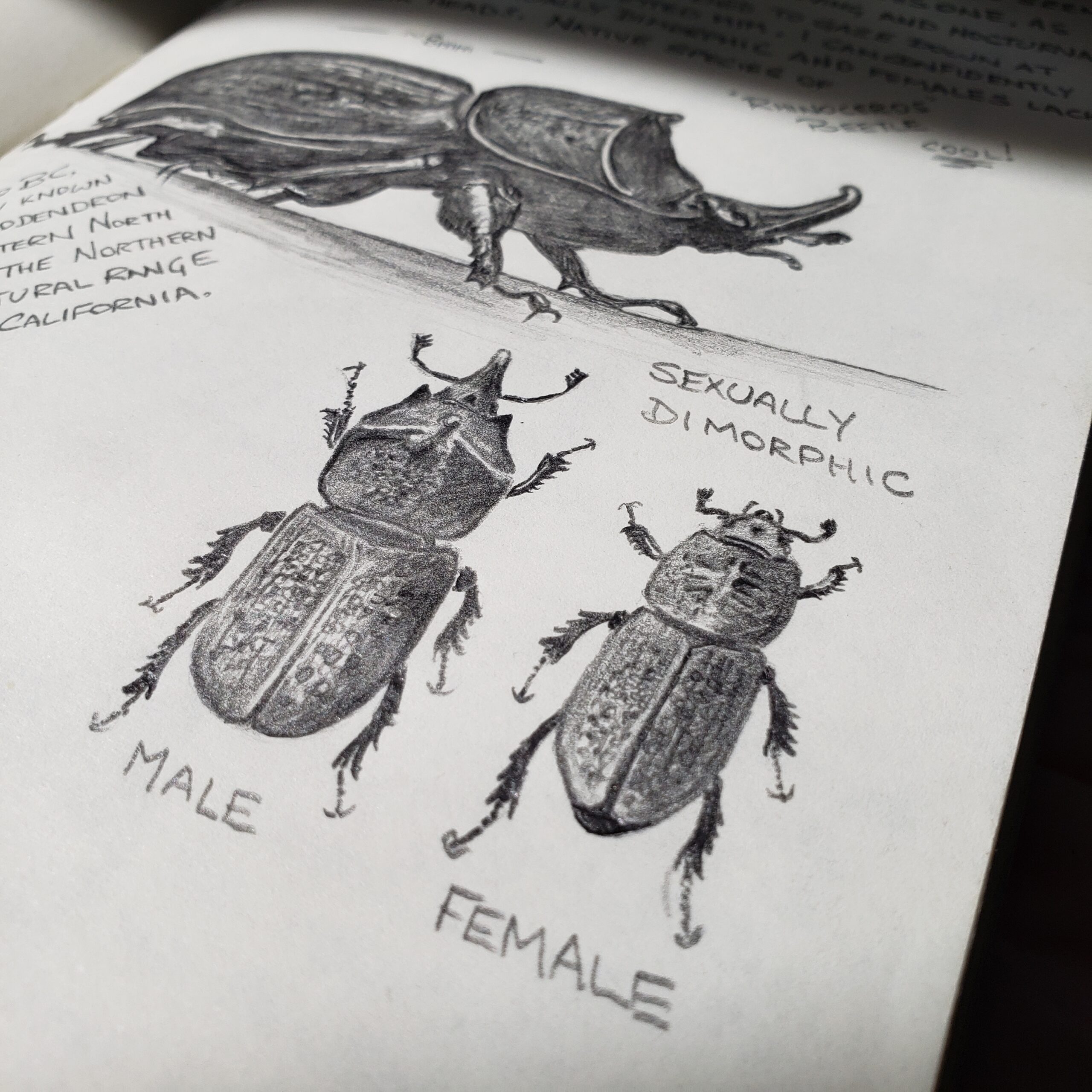
So there you have it. We’re off to a really good start. It is an organism that has a thing on its nose and it’s got wrinkles.. and sure enough, Sinodendron rugosum, sometimes called the rhinoceros beetle, has a horn on it’s nose and a rugose carapace. They are more accurately called Rugose Stag Beetles because the mandibles on the male, which may be as long as the body, are branched and bear a resemblance to the antlers of a stag. However, upon closer inspection, I think this little guy more closely resembles teenie tiny triceratops.

I always grew up thinking rhinoceros beetles were relegated to Europe, with a few of their exotic cousins residing in the jungles of Central America or Africa. Not so.. they are found on every continent except Antarctica.. and this species is in fact a native to British Columbia. He is the first of his species I’ve ever come across, so I’ll try and keep my excitement in check.

I found this little guyon a walk in early July of last year. It was around 7:00pm when I spotted him crawling under a piece of bark on a large fallen alder trunk in the woods near my home. At only 8mm in length, it first looked to be just another common LLB (little brown beetle).. until it caught the light! It turns out that the rugose carapace it’s sporting is also incredibly shiny, almost metallic. The small undulations on its back twinkle like tiny, jet-black jewels.

Like all Stag Beetles, members of family Lucanidae are highly sexually dimorphic. Males feature enlarged head modifications while females, usually smaller in size, do not. Despite its slow speed, S. rugosum is very strong for its size. Like all Stag beetles species, it seems to defy normal physics with its ability to grab on and hold tight with its clawed legs. This comes in handy when males fight eachother in the presence of females.

They are primarily nocturnal and feed on plant matter (alder, birch, maple, oak trees). Females will lay eggs on tree bark and in short order, tiny crescent-shaped, white larvae hatch and begin to tunnel inward, creating pupal chambers. This ultimately damages the tree, buy hey.. they’re soo cute! Who’s a cute little triceratops? Yes, you are..

– Aaron

Posted on

Butterflies

Things have been challenging lately. Lots of medical uncertainties, and family being affected. Currently because of Covid if a family member of yours is admitted to the hospital you can not visit or stay with them while they are even in the ER. You can imagine why I know this for sure.

When I’m stressed, you can count on me doing 2 things well!

Eating, and Painting.

I’ll be damned if I didn’t find a way to do both at the same time. Something I think my buddy Russell the Blacksmith can not claim he can do. I am one of those strange folks who has to do something when I feel powerless to do anything.

I sat down with my paper and colours and what came out? Butterflies. Lots of butterflies. Fragile, tiny and beautiful butterflies. Much like Hope, you want it so badly, but know how quickly it can flutter well out of your reach.

My first butterfly was blue. Been feeling very blue lately. My mother was admitted to the hospital this day.

She was released to go home for the weekend, and my butterflies turned green.

Last night I had a quick visit with her and managed to be out in the park, see beautiful dancers spin pretty pretty lights and fire. My soul was appeased.

Today the butterflies multiplied and became multicoloured. Paint what you know? I believe I paint what I feel. My mother will soon have surgery, we are hopeful for the outcome. <3

Posted on

Tabula villa mea

A map of my home town

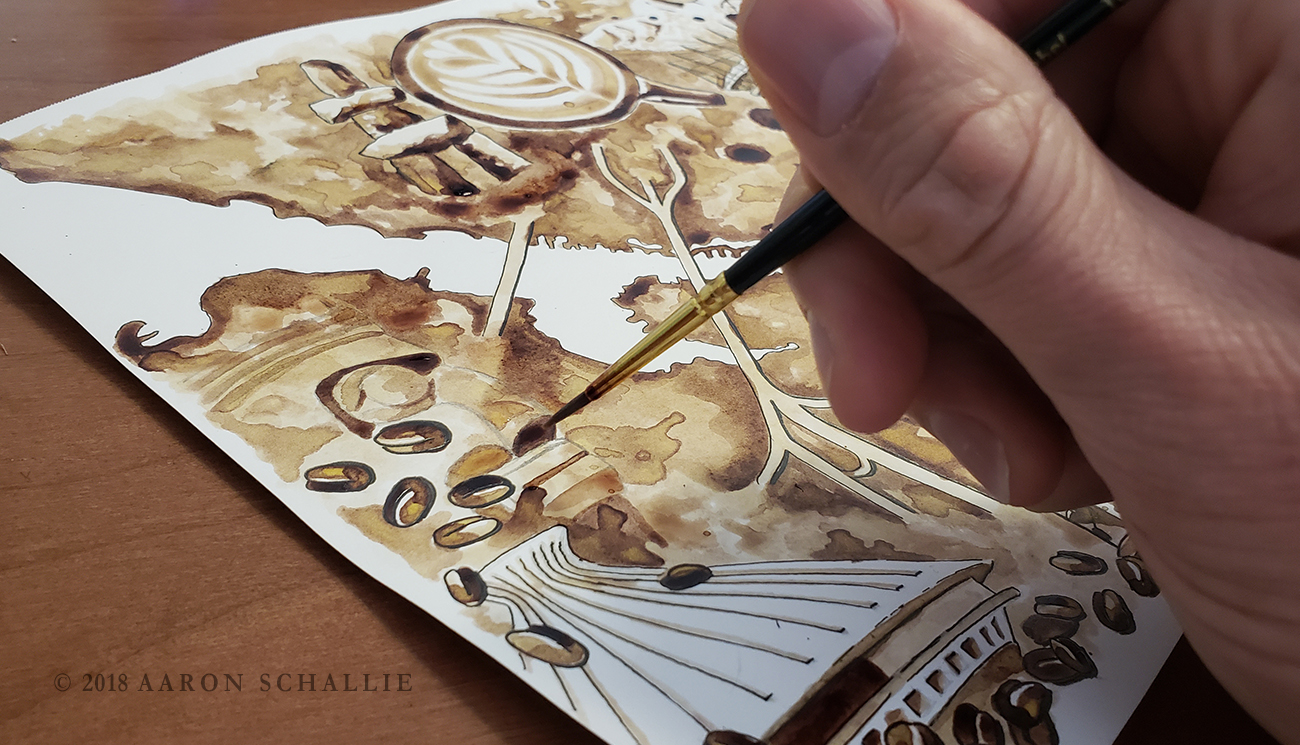
Here’s a fun piece I did back in 2018 of an artistic map of Vancouver’s False Creek seawall. I really enjoyed playing around with ink for the first time. I was hoping to create a spilled-coffee look and I think I found it. Watered down, slowly building up layer upon layer, Winsor and Newton’s Peat Brown Ink did the trick.

Seldom am I found not holding a coffee when I’m out trekking around the city or sitting and drawing on a trail somewhere, so coffee was definitely my inspiration. I’ve even tried painting with coffee.. with some success. The problem with coffee is when it dries, the layers of coffee wipe away unless you spray fixatif or something to seal it. This unfortunately makes things messy and start to run, so I’m glad I found an ink solution.

I was already well into this piece when I happened to come across a Facebook post from Spacing.ca Magazine. Based in Toronto, Spacing is a magazine and website that covers urbanist topics including art, culture, transit, city planning and governance, to name a few. The post was an announcement of their annual Creative Mapping contest and they were looking for artists to submit original creative maps inspired by a Canadian city. The deadline was fast approaching, but I figured I could finish in time.

The painting consists of a map of the False Creek seawall and all three bridges that cross it into downtown. From left to right they are; the Burrard Street Bridge; the Granville Street Bridge; and the Cambie Street Bridge.

Around the painting I included a few of my favourite pieces of public art and iconic buildings in the area. Starting at the top, a latte from any number of the overpriced Yaletown beaneries. To its left, the Inukshuk that stands at Sunset Beach and was the inspiration for Vancouver’s 2010 Winter Olympics logo.

To the right of the latte, stand the majestic North Shore mountains and the Lions peaks. Below that, BC Place Stadium, home of the Vancouver Whitecaps FC and the BC Lions Football team, with its new retractable roof. To the right of the mountains, container cranes at the Port of Vancouver, visible from this part of town, as they tower over Chinatown and Vancouver’s Strathcona neighbourhood.

Below the cranes is the Telus World of Science, a geodesic dome built in time for Expo 86 and home to Vancouver’s own Science World ever since. Below that, more coffee porn in a to-go cup.

The next image is of an Aquabus, one of the many tiny passenger ferries that ply the sheltered waters of False Creek. Standing tall next to the bridge on Granville Island, GIANTS at the Ocean Concrete worksite. Brazilian street artists Os Gemeos were commissioned to paint these monoliths for Vancouver’s 2014 Biennale exhibition.

On the left side of the painting, in the Kits Point neighbourhood, I included the H.R. MacMillan Planetarium. A beautiful building housing the Museum of Vancouver and the space centre. It opened it’s doors to the public in 1968 and was made to resemble a traditional Haida cedar-woven hat.

Finally, the totem pole that stood at the foot of Cypress Street in front of the Vancouver Maritime Museum at Hayden Park. The pole was carved by Mungo Martin with his son David and nephew Henry Hunt to mark the province’s colonial history. Oh yeah, and I framed it all with some coffee beans.

It took me a little over a week to complete.. and yes, my painting was published in the Summer 2018 issue ????

– Aaron

Posted on

Homo nintendonus

Yes, I paint and illustrate cartoons too.

Every now and then, I plug in the old Nintendo. Thankfully, I’ve held on to a couple of old CRT television sets.. and as long as one has a functioning Coaxial or RCA jacks, I’m good to go like it’s nineteen-ninety-one! ..and this time, I happened to have a bunch of my art supplies out on the kitchen table. I didn’t spend a whole lot of time on this one.. I was trying to keep this sketch quick and loose.

Super Mario Bros. 3 is still my ‘go-to’ video game on the NES. I can’t say enough about how great this game is and rightfully, how popular the franchise became in the early 90’s. The toys were junk and the spin-offs were horrible.. horrible good! Anyone remember the Super Mario Brothers Super Show? It’s probably on Netflix.

I thought the game’s UI was particularly exciting. An animated, top-down map of a cartoon world.. with the BEST music to be found on any 80’s, 8-Bit console. Clearly the real inspiration for Google Earth, and maybe why I have such an obsession with maps and cartography ..and mycology, lol.

Come to think of it, this game may have had way more influence on my tastes than I realized. Throughout elementary school, no homework session or assignment seemed complete without a little Koopa Troopa or Power-Up mushroom doodle in the margin.

I guess I’ll have to pullout some of the old issues of Nintendo Power Magazine I have squirrelled away somewhere in the crawlspace, hahaha.

– Aaron

Posted on

Pentidotea wosnesenskii

Exploring Saysutshun on Newcastle Island and getting reacquainted with the Pickle Bug.

Just got back from our first mini-trip since the pandemic hit. A few days in Nanaimo, British Columbia to visit family and a day to explore Saysutshun (Newcastle Island Marine Provincial Park). The island is just a short foot-passenger ferry ride across the harbour from downtown. It was a nice warm, overcast day to pack a picnic and spend some time exploring the intertidal zone during a perfectly timed low tide.

Beautiful little ecosystems, teeming with invertebrate marine life and many species of algae, ring this protected marine park. Almost 30 hectares of this 360 hectare island is easily accessible foreshore. You don’t have to walk far from where the ferry drops you off to start exploring and discovering some pretty funky wildlife.

..and if you head down to the intertidal and flip-over a rock* or find a patch of Pacifc Rockweed (Fucus distichus) riffraff, you’re sure to come across one of these little guys chillin, waiting for the tide to come back in. The Rockweed Isopod, Pentidotea wonsnesenskii.

*Please remember to return any rocks you flip over to as close to its original position as possible.. many of the organisms in these small communities are slow moving and very slow growing. If different areas of the rock are left exposed, sedentary species may have to start growing from scratch, become easier prey or even die. Leave it like you found it.

Usually found clinging to its namesake algal species, trying to keep cool and not dry out during the low tide, the Rockweed Isopod is a harmless, prehistoric looking, non-decapod crustacean. It has seven pairs of very strong legs, perfectly suited to hang on to just about anything, despite living in a habitat prone to strong currents and and extreme exposure.

It is known by a few other names.. Vosnesensky’s isopod, Kelp isopod, Olive-green isopod, Green isopod and the Pickle bug. They are typically an olive-green colour, but can also be tan, brown, yellow, black or pink.

Their colour depends upon the type of algae that they are associated with. Their body colour can change with time, but scientists do not yet understand how this happens; but, it is not related to their diet.

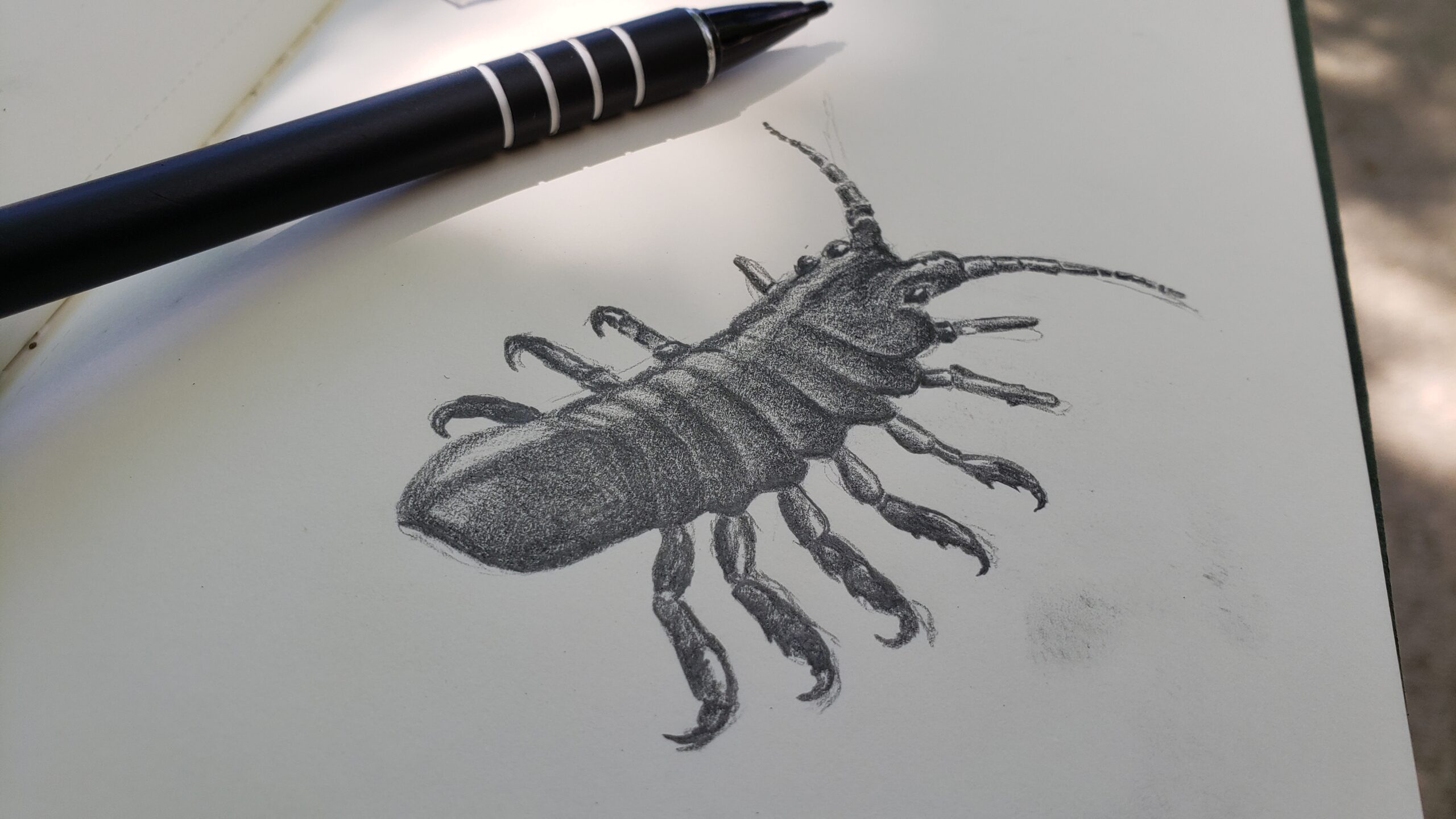
Back home, in Vancouver’s English Bay, rockweed isopods are a little harder to come by. My favourite spot to sit and draw, near the foot of Dunbar on Point Grey Road, has a few. The local colouration, seems to be dark brown to jet-black and back in 2019, I had a chance to sketch the subject.

As you can see, I didn’t quite finish it. I was planning to fill it up and add some more info.. but honestly, I had forgotten all about this drawing. Thankfully, my recent trip reminded me, and maybe I’ll take another crack at sketching this neat little marine invert again soon.

– Aaron

Posted on

Isn’t Metal Already Hard?

The Cleaver: Part 2

Back in the shop and today was all about refining the shape, rough grinding and then the most nerve wracking process for a cutler; hardening!

Again, I am faced with the shadows of envy when I start writing a post. The envy being that my fellow artists here have the luxury of not only having a clean space for taking pictures (it is amazing how quickly the speakers on one’s phone collect metal dust and shavings in the shop), but that they can take pictures as things progress easily! In smithing one has about 15-30 seconds of workable heat (depending on the mass of material you are working with) once you take a piece out of a forge. Of that, only the 3/4 of that heat is useful for effectively forging out material. The rest is straightening and truing up material. Every heat takes time and also adds scale to the material and reduces the overall mass, so fewer heats is always best to maintain the cleanest end result.

But I digress. The end of all this wining and excuses is this: I will do what I can to get interesting ‘Work in Progress’ pictures, but there will be some inevitable gaps in process. Best thing is to get in touch and book a quick intro lesson to see it all for yourself (yes, yes…shameless plug. Totally ineffective given a global pandemic too!)

I try to forge as closely as possible to final shape given that I enjoy smithing and not so much grinding! Regardless, I am not proficient enough to eliminate the entire cleanup process with a grinder and above, you can see the layouts for the final blade shape. Further, the integral bolster was refined on the bottom roller of my Oregon Blade Maker 2″ x 72″ belt grinder. I lucked out that it was the right profile, but I think that the next thing on the ever evolving shopping list is going to be a set of small-diameter contact wheels. Getting into tight radius areas when shaping things like handle transitions and such is just so much nicer to do via power tools rather than files!

After rough shaping, it is all about the heat treatment. Heat treatment is the process where one takes the material to a specific temperature, then quenched in order to increase the hardness of the material. I’ll get into the specifics of all that in a later post (I find it fascinating, but I can imagine that it isn’t quite as interesting as glowing metal). First stage of heat treatment however is normalization: heating the material above the critical temperature, holding it there for a period of time, then cooling off in air. During heavy forging stresses develop within the crystal structure of the metal. This normalization process serves to normalize the entire structure and both reduce the likely of fractures and refines the grain structure (again, more on this later when I get into Shop Metallurgy).

So pretty isn’t it! After the normalization, more grinding! You can see that there was some additional material I needed to deal with at the tip to even out the thickness. Following normalization and any additional tweaks, it is time for the quench! Take a piece of hardenable steel (again, more on that later), bring it past the critical point and rapidly cool according to the material requirements. For most spring steel, this quench happens in warmed oil – I use canola – as it achieves the correct speed of cooling. Other steels will have different requirements and require either faster or slower quenches. Some steels also harden when cooled in still air (most stainless steels).

Know what you are using and apply the correct heat treatment process! This is one of the biggest dangers of Mystery Scrap Steels – you really don’t know what it is you are using. You can see if it is a mild, carbon or stainless steel, but the specifics are lost without a metallurgical analysis unavailable in a small shop.

And again, I digress…

After the quench, the material is exceptionally hard (if you did everything correct) and therefore brittle. To make this a useful tool, one needs to strike a balance between hard/brittle and soft/malleable. This process is tempering – bringing a material up to a significantly lower temperature to loose some of the hardness and bring in a level of malleability. For this material, a 400°F for two hours – repeated twice – brings down the hardness to a nice balance!

Yes, I used my kitchen oven. This process isn’t any different that seasoning a cast iron pan! I would like to draw your attention to the hammer marks on the blade for a moment. I always try to forge as clean and straight as possible, however the customer wanted a ‘brute du forge’ look for this blade to reduce material sticking to the blade when getting through large chunks of animal. As I had completely forgot about this and was exceptionally careful about forging as clean as possible, I then had to add back the marks. Ahh well, lets consider this a lesson in ‘Pay Attention to the Design Brief!’.

All in all, I think it is coming along very nicely! The next part will be all about finishing and adding a handle! To be honest, my least favorite part of the entire process…

Posted on

She Can Kill You With Her Mind


I am a huge Firefly fan. The dialogue, the character development and the stories of a dysfunctional family are perfect, and very relatable. River Tam has a special place in my heart, as she is also a dancer. Her movements in her choreography were fluid and beautiful. She starts off needed rescuing, but in the end to save the world she had to stop being afraid of the gifts she had. Not only that, she’s a kick ass girl who understands what family means.

She Always Did Love To Dance

Maybe I have a thing for Warrior Women. But really… Who doesn’t?

Take My Life, Take My land, Take Me Where I Can Not Stand… I Don’t Care, I’m Still Free.

You can’t take the sky from me.

Joss Whedon & Sonny Rhodes
Posted on

Birthday Shop Day!

When you can’t go do anything really fun with your nephew for his birthday due to Covid-19, build things!

One of the coolest things that my partner Melissa and I have decided to do for our niece and nephew is our ongoing plans for their birthdays. While everyone loves getting stuff (read: toys!) for one’s birthday, our niece and nephew have a number of other relatives that more than adequately fulfill that need. We had heard this plan from one of our fellow paragliding pilots and loved the idea: give experiences, not stuff! So, starting on their 9th birthdays, we started to give them the gift of ‘Whatever you want to do today, we will go do!’. So far there have been two day-long trips to arcades and a trip to a pottery studio.

This year was supposed to be a fossil hunting trip to Vancouver Island, however Covid has made that an uncomfortable and very possibly dangerous process what with ferries full of boneheads who can’t seem to understand how polite society behaves during a global pandemic! So, the proposal was made to spend the day in my shop and make some stuff! Specifically, making a set of three lache bars for W’s home Ninja Gym.

It was such an outstandingly amazing experience to share what I love with my nephew! He was amazing too; before this he had never used a power tool in his life with the exception of a hot glue gun! He paid attention, listened and above all asked questions when he didn’t understand something. I had been prepared to do most of the work and have him there just helping out however in reality and without any Uncle Russ Hyperbole he did 95% of the work!!

We went through the whole process of design, dimensions, sourcing materials, marking, drilling, cutting and assembling in about 4 hours. The nice thing was that the 36″ threaded pipe was the perfect size for his needs (he wanted 34″ long bars), so our work was largely reduced to marking out and drilling holes, then cutting bolts to length prior to attachment. We got done about an hour before dinner, so I suggested we could do a bit of smithing; you know, if he wanted to…Enthusiastic nodding ensued and a small coathook was made! I had to do a bit more here as the anvil was just a bit too tall for him (I will be now on the lookout for an inexpensive small anvil to add to the tripping hazards in my shop), but he loved the whole process!

All in all, an outstanding time had by all! 14/10 Would do again with either him or his sister M!