Posted on

Equisetum telmateia

A Horsetail for the ages.

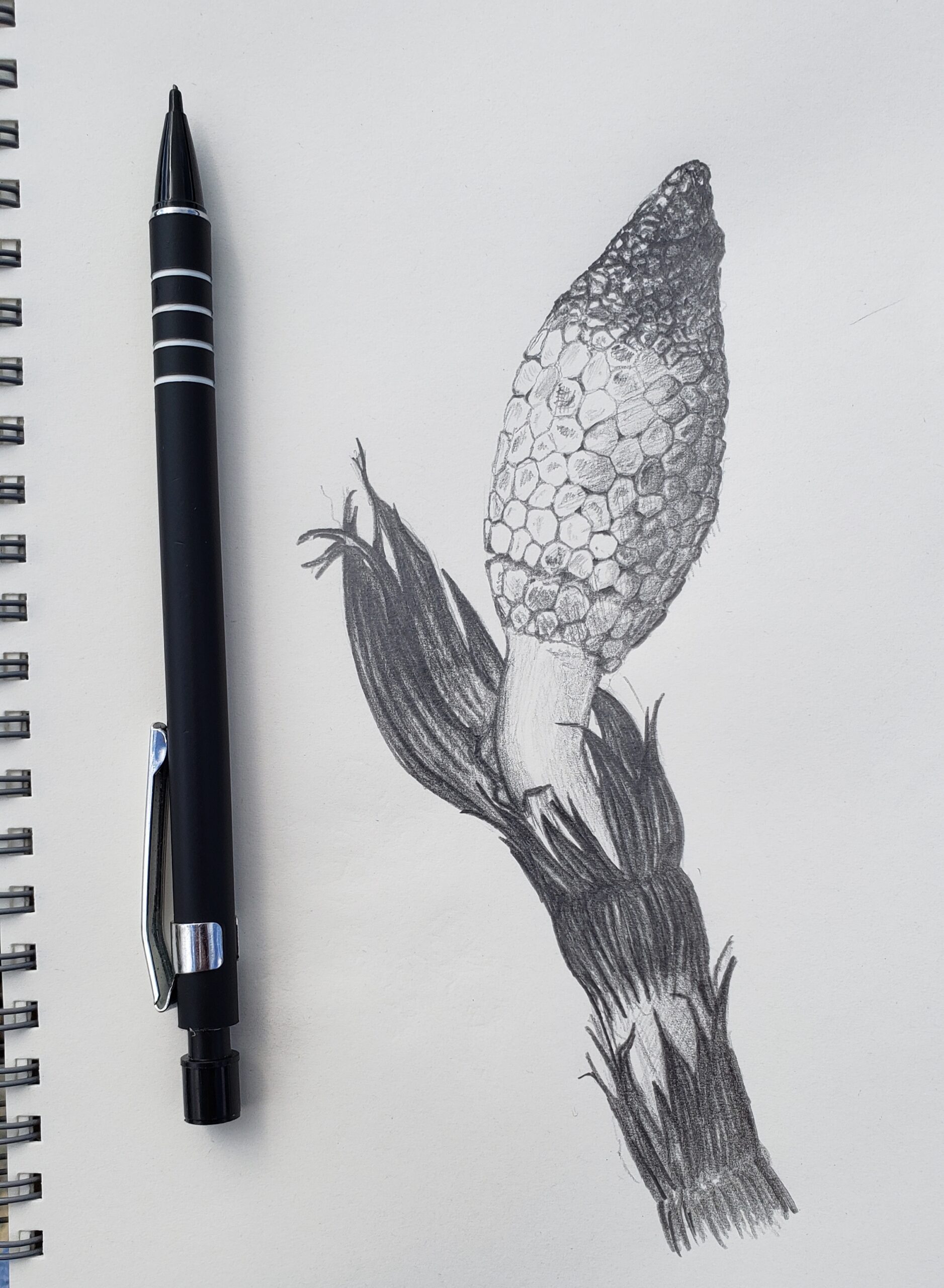
This is Equisetum telmateia. Or more accurately, this is a late spring, newly emerge fertile stem of the Equisetum telmateia. Its a herbaceous perennial, native to British Columbia, and I found this one growing on the side of Burnaby Mountain.

I remember my dad telling me all about this species as a kid. We use to see a lot of it growing around the edge of Magic Lake on Pender Island where my grandparents lived. It was a neat little plant you could pull apart and put back together like a puzzle.

It’s pale yellowish, non-photosynthetic, spore-bearing, fertile stem only lasts a short while before dying right back and being taken over by the more familiar green, herbaceous, photosynthetic, sterile stems.

At the top of the stem is the cone-like, reproductive portion of the plant, called the strobilus. It is comprised of row upon row of hexagonal spore-bearing structures. Each little hexagon produces thousands of tiny spores.

When released, a spore will start to grow into a new plant, which is either bisexual or male. Sperm are produced by the new plants, complete with tiny flagella, and swim through the water in search of female plants. Once fertilized, the plant will grow to maturity, starting the cycle over again.

Having existed since the Devonian era in the great Carboniferous period, horsetails are true living fossils. There are only about twenty species of horsetail in the world, all in one group, or genus, known as Equisetum. Ten species are found in British Columbia, and six of these exist on Vancouver Island and in the Lower Mainland.

Horsetails are a part of a unique group of plants, halfway between primitive plants like mosses, and more highly evolved flowering seed plants (angiosperms and gymnosperms). Horsetails produce spores, like ferns and mosses, not seeds. Yet Horsetails have specialized vascular tissues for conducting water, food and minerals through the stem, unlike the more primitive bryophytes or so-called ‘lower vascular’ plants.

400 million years ago saw the planet dominated by these lower vascular plants, which at the time included species that grew as tall as buildings. In fact forests existed for so long, and grew so large, their remains provide the bulk of the world’s coal beds.

As for any beneficial uses, sorry folks, despite centuries of use in traditional medicine, there is no evidence that Equisetum has any medicinal properties.

However the stems are coated with abrasive silicates, making them useful for scouring (cleaning) metal items such as cooking pots or drinking mugs, particularly those made of tin. Equisetum hyemale, rough horsetail, is still boiled and then dried in Japan to be used for the final polishing process on woodcraft to produce a smoother finish than any sandpaper.

– Aaron

Posted on

Lichens

Those who lichen.. lichen a lot.

So lichens are cool. I mean, what’s NOT to lichen? Composite organisms consisting of both a fungus and a simple photosynthesizing organism like algae or cyanobacteria. Up close, lichens reveal an amazing array of colour and tiny networks.. daunting if your plan is to try and draw the darn thing.

But I’m a sucker for patterns.. especially naturally occurring ones. Lichens are just that! Big ol mess of repeatin patterns. And I’ll admit, this is probably the one organism that I just couldn’t (still haven’t) fully wrapped my head around. Soooo much fine detail!

As a subject of study and appreciation lichens, no matter the type, really try and draw you in to their labyrinth of detail. I start to feel this obligation to share EXACTLY what I’m seeing in person. This is when I remind myself, that this is why the photograph was invented.

But as abstract inspiration, the possibilities seem endless. So I guess, here is a first look at a few of my attempts at capturing the lichen world.. and I might as well toss some learnin out there too.

As in all my posts, I take all my own photos with my trusty Samsung Galaxy S9 (cutting edge technology folks).. no editing, just some cropping. All of these lichens were observed within a 15 minute radius of my house in Burnaby, British Columbia, with the exception of the two photographs below. The yellow crustose lichen was found on a south-facing rock at the peak of Whistler Mountain, and the grey crustose lichen was found growing at Lighthouse Park in West Vancouver.

Lichens are grouped into three main types:

  • Foliose – which have a leaf-like appearance.
  • Fruticose – are highly branched, either hanging or standing up.
  • Crustose – are the ones that look like a crust that has formed on a surface like a rock or tree trunk.

The algal (or bacterial) component is the autotroph in this relationship. It supplies the nutrients to the organism through photosynthesis. The fungus protects the algae from desiccation and also provides it with a means to grow and attach to whatever substrate.

..and if you enjoy being bombarded by Latin and scientific terminology, do yourself a huge favor and look up lichen taxonomic classification or Lichen Growth forms and internal structures. Good times my geeky friends!

They are slooooooow growing and everywhere. It is estimated that 6% of Earth’s land surface is covered by lichens. And they are not a picky lot either. Some lichens were exposed to Martian atmospheric conditions in the lab for a period of over 3 weeks in 2012.  Despite the weak atmospheric pressure, lack of protection from cosmic radiation, bitter cold and alien atmospheric composition, some species not only survived, but continued to grow and function with relative normality! Lichens can even grow on plastic.

Hummingbirds and other nest building species use lichen for nest building and camouflage. Lichens can even be used in making dyes and perfumes, as well as traditional medicines.

Lichens are eaten by many different cultures as well, though its generally when times are lean. Lichens are not very easy to digest and contains minimal nutritional content. And of course, a few lichen species are eaten by insects and larger animals such as reindeer. Remember kids, no reindeer, no Christmas!

So love a lichen! A delicate, yet resilient organism that’s been practicing unchecked socialist behavior in our forests, across our tundra, and on the sides of volcanoes since the beginning of time (or at least since the devonian). Living in mutually beneficial, symbiotic, cross-species, relationships. Buncha single-celled hippies.. chillin, sharin.

– Aaron

Posted on

Ad Primum Tempus

My Very First Post.. Better Make it a Good One!

Welcome to the Hammer and Pen Artist Collective, a group of artists that create things and share them, here. My name is Aaron Schallie and I’m an illustrator living in Burnaby, a suburb of Vancouver, Canada.

Roughly two years ago, I made a commitment to revisit and improve upon the drawing skills I’ve had since childhood. I had just moved to a new neighbourhood and was presented with a beautiful, brand-new environment to explore, on the edge of a sizable urban forest. What better excuse could I have to be creative and learn.

There were plenty of great subjects to work on and fascinating places to explore. An incredible contrast to living so close to downtown Vancouver, with it’s quick access to beaches and the marine life I was already so familiar with. This ‘neck-of-the-woods’ presented an interesting mountain topography, lots of new critters, and over three dozen trails covering 30+ kilometers. These trails crisscross several distinct watersheds that drain in every direction of the compass. The top of the mountain is crowned with one of Western Canada’s most beautiful architectural jewels, the main campus of Simon Fraser University, designed by Arthur Erickson.

I was surrounded by inspiration.. it was game on.

Since then, I’ve filled more than a dozen moleskine cahiers and sketchbooks and have come to know the ‘mountain’ like the back of my hand. At home, I’ve created a small workspace dedicated to my art projects and supplies, and now have a small functional shop space in the garage, brimming with the potential for much larger projects. I started small, but I’m aiming to create much larger works and possibly explore print making. For now, I try never to leave the house without out something to draw on and I’m keeping it simple.

I mainly use pencil, pen and ink and have started to incorporate some watercolour. I try to draw everyday and give myself regular challenges to improve my skills. Sometimes these challenges lead to more detailed studies of subjects I find in my local environment.

Of course, life’s busy pace and, uh.. a certain global pandemic.. can make allocating time for art difficult. But I try to foster creativity as often as I can and manage to fit it in whenever possible. Most recently I’ve been focused on botanical and biological detail, but I also explore more abstract approaches and sometimes gravitate to subjects in the urban landscape as well.

Over the past couple years, I also remembered to take photos of a lot of my work’s incremental progress, in the hopes I might one day get the chance to share them. This blog is finally that chance. I’m looking forward to sharing some of the steps and challenges in my journey, show off some of my available work, and hopefully inspire others to pickup a pencil and draw. I’ll keep my past works in my Throwback Posts is you’re keen to follow along.

Once we get settled in a bit, I’m looking forward to offering classes, guided walks and plein air sessions. Until then, I hope you enjoy my posts. Let’s get started.

– Aaron.