Posted on

Lichens

Those who lichen.. lichen a lot.

So lichens are cool. I mean, what’s NOT to lichen? Composite organisms consisting of both a fungus and a simple photosynthesizing organism like algae or cyanobacteria. Up close, lichens reveal an amazing array of colour and tiny networks.. daunting if your plan is to try and draw the darn thing.

But I’m a sucker for patterns.. especially naturally occurring ones. Lichens are just that! Big ol mess of repeatin patterns. And I’ll admit, this is probably the one organism that I just couldn’t (still haven’t) fully wrapped my head around. Soooo much fine detail!

As a subject of study and appreciation lichens, no matter the type, really try and draw you in to their labyrinth of detail. I start to feel this obligation to share EXACTLY what I’m seeing in person. This is when I remind myself, that this is why the photograph was invented.

But as abstract inspiration, the possibilities seem endless. So I guess, here is a first look at a few of my attempts at capturing the lichen world.. and I might as well toss some learnin out there too.

As in all my posts, I take all my own photos with my trusty Samsung Galaxy S9 (cutting edge technology folks).. no editing, just some cropping. All of these lichens were observed within a 15 minute radius of my house in Burnaby, British Columbia, with the exception of the two photographs below. The yellow crustose lichen was found on a south-facing rock at the peak of Whistler Mountain, and the grey crustose lichen was found growing at Lighthouse Park in West Vancouver.

Lichens are grouped into three main types:

  • Foliose – which have a leaf-like appearance.
  • Fruticose – are highly branched, either hanging or standing up.
  • Crustose – are the ones that look like a crust that has formed on a surface like a rock or tree trunk.

The algal (or bacterial) component is the autotroph in this relationship. It supplies the nutrients to the organism through photosynthesis. The fungus protects the algae from desiccation and also provides it with a means to grow and attach to whatever substrate.

..and if you enjoy being bombarded by Latin and scientific terminology, do yourself a huge favor and look up lichen taxonomic classification or Lichen Growth forms and internal structures. Good times my geeky friends!

They are slooooooow growing and everywhere. It is estimated that 6% of Earth’s land surface is covered by lichens. And they are not a picky lot either. Some lichens were exposed to Martian atmospheric conditions in the lab for a period of over 3 weeks in 2012.  Despite the weak atmospheric pressure, lack of protection from cosmic radiation, bitter cold and alien atmospheric composition, some species not only survived, but continued to grow and function with relative normality! Lichens can even grow on plastic.

Hummingbirds and other nest building species use lichen for nest building and camouflage. Lichens can even be used in making dyes and perfumes, as well as traditional medicines.

Lichens are eaten by many different cultures as well, though its generally when times are lean. Lichens are not very easy to digest and contains minimal nutritional content. And of course, a few lichen species are eaten by insects and larger animals such as reindeer. Remember kids, no reindeer, no Christmas!

So love a lichen! A delicate, yet resilient organism that’s been practicing unchecked socialist behavior in our forests, across our tundra, and on the sides of volcanoes since the beginning of time (or at least since the devonian). Living in mutually beneficial, symbiotic, cross-species, relationships. Buncha single-celled hippies.. chillin, sharin.

– Aaron
Posted on

Tabula villa mea

A map of my home town

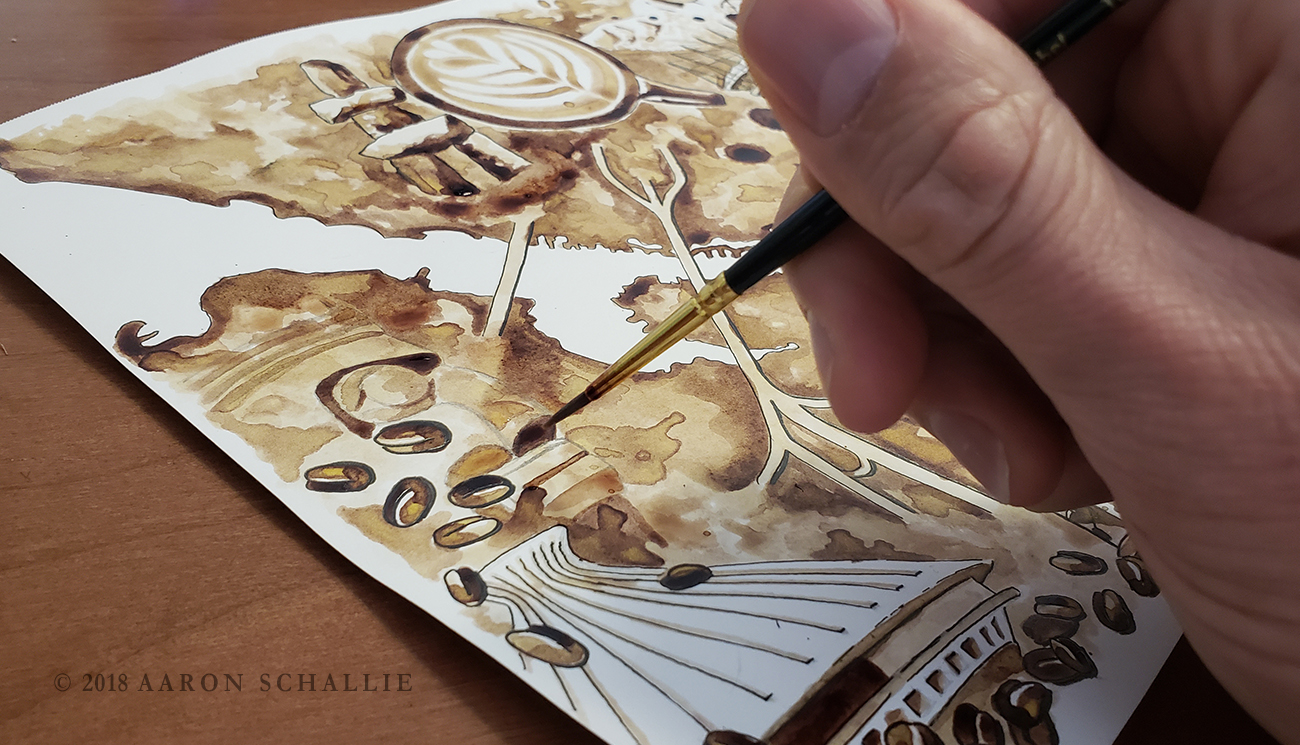
Here’s a fun piece I did back in 2018 of an artistic map of Vancouver’s False Creek seawall. I really enjoyed playing around with ink for the first time. I was hoping to create a spilled-coffee look and I think I found it. Watered down, slowly building up layer upon layer, Winsor and Newton’s Peat Brown Ink did the trick.

Seldom am I found not holding a coffee when I’m out trekking around the city or sitting and drawing on a trail somewhere, so coffee was definitely my inspiration. I’ve even tried painting with coffee.. with some success. The problem with coffee is when it dries, the layers of coffee wipe away unless you spray fixatif or something to seal it. This unfortunately makes things messy and start to run, so I’m glad I found an ink solution.

I was already well into this piece when I happened to come across a Facebook post from Spacing.ca Magazine. Based in Toronto, Spacing is a magazine and website that covers urbanist topics including art, culture, transit, city planning and governance, to name a few. The post was an announcement of their annual Creative Mapping contest and they were looking for artists to submit original creative maps inspired by a Canadian city. The deadline was fast approaching, but I figured I could finish in time.

The painting consists of a map of the False Creek seawall and all three bridges that cross it into downtown. From left to right they are; the Burrard Street Bridge; the Granville Street Bridge; and the Cambie Street Bridge.

Around the painting I included a few of my favourite pieces of public art and iconic buildings in the area. Starting at the top, a latte from any number of the overpriced Yaletown beaneries. To its left, the Inukshuk that stands at Sunset Beach and was the inspiration for Vancouver’s 2010 Winter Olympics logo.

To the right of the latte, stand the majestic North Shore mountains and the Lions peaks. Below that, BC Place Stadium, home of the Vancouver Whitecaps FC and the BC Lions Football team, with its new retractable roof. To the right of the mountains, container cranes at the Port of Vancouver, visible from this part of town, as they tower over Chinatown and Vancouver’s Strathcona neighbourhood.

Below the cranes is the Telus World of Science, a geodesic dome built in time for Expo 86 and home to Vancouver’s own Science World ever since. Below that, more coffee porn in a to-go cup.

The next image is of an Aquabus, one of the many tiny passenger ferries that ply the sheltered waters of False Creek. Standing tall next to the bridge on Granville Island, GIANTS at the Ocean Concrete worksite. Brazilian street artists Os Gemeos were commissioned to paint these monoliths for Vancouver’s 2014 Biennale exhibition.

On the left side of the painting, in the Kits Point neighbourhood, I included the H.R. MacMillan Planetarium. A beautiful building housing the Museum of Vancouver and the space centre. It opened it’s doors to the public in 1968 and was made to resemble a traditional Haida cedar-woven hat.

Finally, the totem pole that stood at the foot of Cypress Street in front of the Vancouver Maritime Museum at Hayden Park. The pole was carved by Mungo Martin with his son David and nephew Henry Hunt to mark the province’s colonial history. Oh yeah, and I framed it all with some coffee beans.

It took me a little over a week to complete.. and yes, my painting was published in the Summer 2018 issue ????

– Aaron

Posted on

Homo nintendonus

Yes, I paint and illustrate cartoons too.

Every now and then, I plug in the old Nintendo. Thankfully, I’ve held on to a couple of old CRT television sets.. and as long as one has a functioning Coaxial or RCA jacks, I’m good to go like it’s nineteen-ninety-one! ..and this time, I happened to have a bunch of my art supplies out on the kitchen table. I didn’t spend a whole lot of time on this one.. I was trying to keep this sketch quick and loose.

Super Mario Bros. 3 is still my ‘go-to’ video game on the NES. I can’t say enough about how great this game is and rightfully, how popular the franchise became in the early 90’s. The toys were junk and the spin-offs were horrible.. horrible good! Anyone remember the Super Mario Brothers Super Show? It’s probably on Netflix.

I thought the game’s UI was particularly exciting. An animated, top-down map of a cartoon world.. with the BEST music to be found on any 80’s, 8-Bit console. Clearly the real inspiration for Google Earth, and maybe why I have such an obsession with maps and cartography ..and mycology, lol.

Come to think of it, this game may have had way more influence on my tastes than I realized. Throughout elementary school, no homework session or assignment seemed complete without a little Koopa Troopa or Power-Up mushroom doodle in the margin.

I guess I’ll have to pullout some of the old issues of Nintendo Power Magazine I have squirrelled away somewhere in the crawlspace, hahaha.

– Aaron

Posted on

Acer circinatum

Going out on a limb here.. No, no.. Branching out.. No wait, “Don’t Stop Be leafing” ..yeah, that one.

(TREE PUNS)

Much like myself, the Vine Maple is from Western North America and is usually found within 300 km of the Pacific Ocean. Good choice.

Another awesome local species, Acer circinatum features bright green and chartreuse branches, white flowers with deep-red sepals, and brightly coloured red and green, winged fruit. It has symmetrical, almost round, palmate leaves that turn from green to golden yellow in the fall. Typically, each leaf has 7 to 9 lobes.. lots of interesting lines, shapes and colours to consider when setting out to capture an artistic likeness of this specimen.

One of the most recognizable characteristics of the Vine maple tree is its penchant to twist, bend and droop. Branches regularly grow horizontally, often changing direction and sometimes bending right over, coming into contact with the ground. This can cause the top of the tree to grow a new root system, creating natural archways. This characteristic makes it the only maple capable of layering, adding a uniquely West Coast flair to out wooded areas.

A few stunningly complex tangles come to mind locally in; Stanley Park, especially along the trails near Beaver Pond; Tynehead Regional Park in Surrey; Campbell Valley and along the Fort-to-Fort Trail in Langley; Mundy Park in Coquitlam; Deer Lake Park in Burnaby; and Buntzen Lake in Anmore, to name a few. All have beautiful examples of established (probably second- or third-growth by now) Vine maple specimens, 30-40+ years old and highly visible from the many walking paths and trails.

I didn’t really have anything specific in mind at first. I had just returned from a walk and had taken a few pictures of some rain soaked Vine maple branches along the way. It was early February and there were few living leaves to be found in the woods. With no foliage to obstruct my view, theses branches stood out against the browned and mostly dormant forest, like over-sized stalks of fresh asparagus.

Their colour stayed with me the entirety of my walk back and I tried my beginners best to replicate it in watercolor when I got home. I started with the branches and decided to add the fruit and flowers next. I really think I need to work on my color mixing, but overall I’m happy with it. I’m still a bit reluctant to add text. I think it needs it, but I’ll probably come back to it one day with a bit more purpose.

– Aaron

Posted on

Vespula alascensis

Northern Common Yellowjacket.

I’m tackling a new organism here with my good old Windsor & Newton watercolours. I love any excuse to use yellow and black together.

Did you know queens are the only members of the colony able of surviving the winter. In April or May, the queen begins each season by selecting a suitable location to constructs a small nest. It then raises sterile daughter offspring. These sterile workers then take over the duties of enlarging and maintaining the nest, foraging for food and caring for the offspring while the queen functions only to produce more eggs.

– Aaron

Posted on

Ad Primum Tempus

My Very First Post.. Better Make it a Good One!

Welcome to the Hammer and Pen Artist Collective, a group of artists that create things and share them, here. My name is Aaron Schallie and I’m an illustrator living in Burnaby, a suburb of Vancouver, Canada.

Roughly two years ago, I made a commitment to revisit and improve upon the drawing skills I’ve had since childhood. I had just moved to a new neighbourhood and was presented with a beautiful, brand-new environment to explore, on the edge of a sizable urban forest. What better excuse could I have to be creative and learn.

There were plenty of great subjects to work on and fascinating places to explore. An incredible contrast to living so close to downtown Vancouver, with it’s quick access to beaches and the marine life I was already so familiar with. This ‘neck-of-the-woods’ presented an interesting mountain topography, lots of new critters, and over three dozen trails covering 30+ kilometers. These trails crisscross several distinct watersheds that drain in every direction of the compass. The top of the mountain is crowned with one of Western Canada’s most beautiful architectural jewels, the main campus of Simon Fraser University, designed by Arthur Erickson.

I was surrounded by inspiration.. it was game on.

Since then, I’ve filled more than a dozen moleskine cahiers and sketchbooks and have come to know the ‘mountain’ like the back of my hand. At home, I’ve created a small workspace dedicated to my art projects and supplies, and now have a small functional shop space in the garage, brimming with the potential for much larger projects. I started small, but I’m aiming to create much larger works and possibly explore print making. For now, I try never to leave the house without out something to draw on and I’m keeping it simple.

I mainly use pencil, pen and ink and have started to incorporate some watercolour. I try to draw everyday and give myself regular challenges to improve my skills. Sometimes these challenges lead to more detailed studies of subjects I find in my local environment.

Of course, life’s busy pace and, uh.. a certain global pandemic.. can make allocating time for art difficult. But I try to foster creativity as often as I can and manage to fit it in whenever possible. Most recently I’ve been focused on botanical and biological detail, but I also explore more abstract approaches and sometimes gravitate to subjects in the urban landscape as well.

Over the past couple years, I also remembered to take photos of a lot of my work’s incremental progress, in the hopes I might one day get the chance to share them. This blog is finally that chance. I’m looking forward to sharing some of the steps and challenges in my journey, show off some of my available work, and hopefully inspire others to pickup a pencil and draw. I’ll keep my past works in my Throwback Posts is you’re keen to follow along.

Once we get settled in a bit, I’m looking forward to offering classes, guided walks and plein air sessions. Until then, I hope you enjoy my posts. Let’s get started.

– Aaron.