
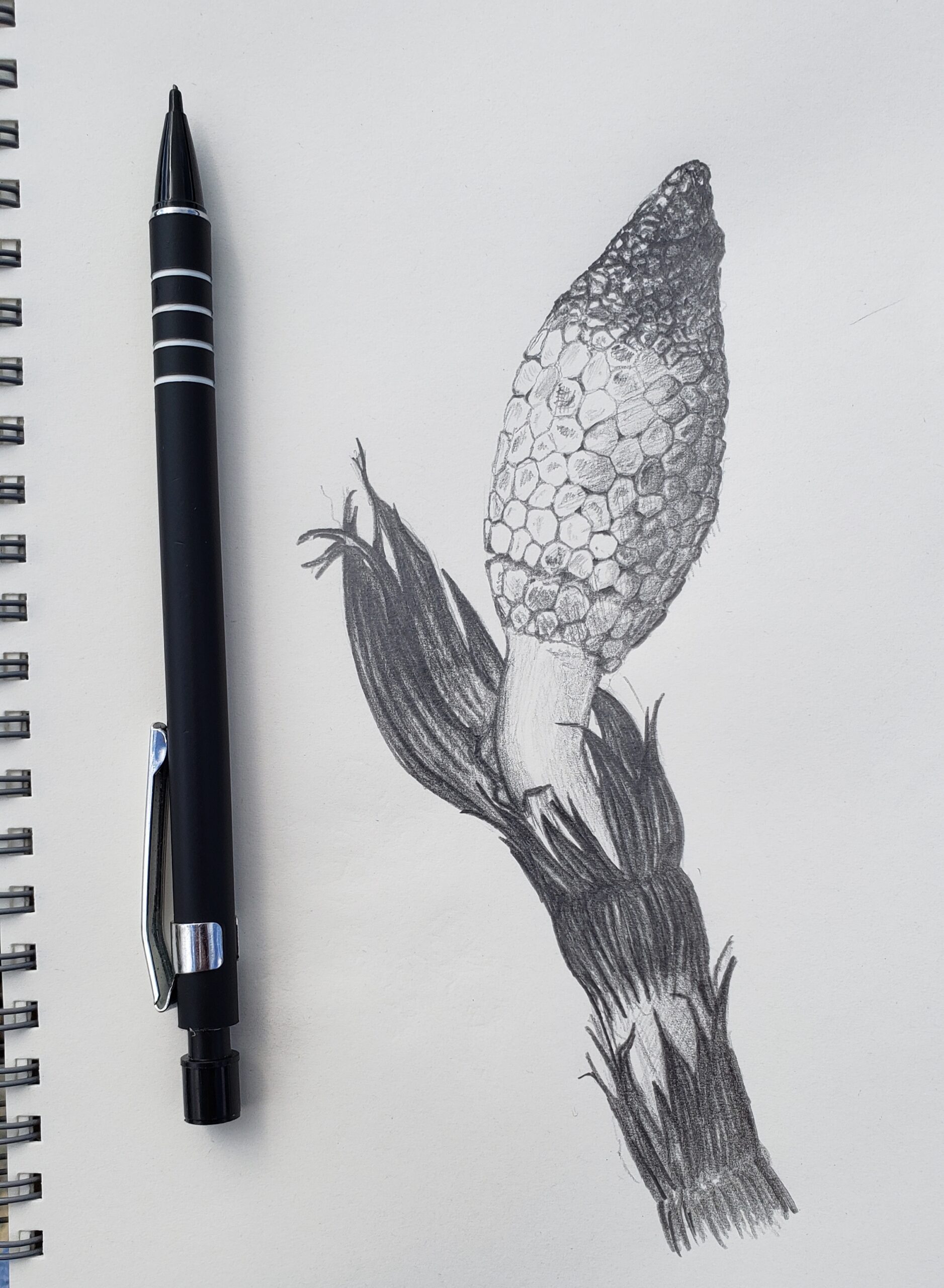
A Horsetail for the ages.
This is Equisetum telmateia. Or more accurately, this is a late spring, newly emerge fertile stem of the Equisetum telmateia. Its a herbaceous perennial, native to British Columbia, and I found this one growing on the side of Burnaby Mountain.

I remember my dad telling me all about this species as a kid. We use to see a lot of it growing around the edge of Magic Lake on Pender Island where my grandparents lived. It was a neat little plant you could pull apart and put back together like a puzzle.


It’s pale yellowish, non-photosynthetic, spore-bearing, fertile stem only lasts a short while before dying right back and being taken over by the more familiar green, herbaceous, photosynthetic, sterile stems.


At the top of the stem is the cone-like, reproductive portion of the plant, called the strobilus. It is comprised of row upon row of hexagonal spore-bearing structures. Each little hexagon produces thousands of tiny spores.


When released, a spore will start to grow into a new plant, which is either bisexual or male. Sperm are produced by the new plants, complete with tiny flagella, and swim through the water in search of female plants. Once fertilized, the plant will grow to maturity, starting the cycle over again.


Having existed since the Devonian era in the great Carboniferous period, horsetails are true living fossils. There are only about twenty species of horsetail in the world, all in one group, or genus, known as Equisetum. Ten species are found in British Columbia, and six of these exist on Vancouver Island and in the Lower Mainland.

Horsetails are a part of a unique group of plants, halfway between primitive plants like mosses, and more highly evolved flowering seed plants (angiosperms and gymnosperms). Horsetails produce spores, like ferns and mosses, not seeds. Yet Horsetails have specialized vascular tissues for conducting water, food and minerals through the stem, unlike the more primitive bryophytes or so-called ‘lower vascular’ plants.


400 million years ago saw the planet dominated by these lower vascular plants, which at the time included species that grew as tall as buildings. In fact forests existed for so long, and grew so large, their remains provide the bulk of the world’s coal beds.

As for any beneficial uses, sorry folks, despite centuries of use in traditional medicine, there is no evidence that Equisetum has any medicinal properties.
However the stems are coated with abrasive silicates, making them useful for scouring (cleaning) metal items such as cooking pots or drinking mugs, particularly those made of tin. Equisetum hyemale, rough horsetail, is still boiled and then dried in Japan to be used for the final polishing process on woodcraft to produce a smoother finish than any sandpaper.
– Aaron


