Posted on

Acer circinatum

Going out on a limb here.. No, no.. Branching out.. No wait, “Don’t Stop Be leafing” ..yeah, that one.

(TREE PUNS)

Much like myself, the Vine Maple is from Western North America and is usually found within 300 km of the Pacific Ocean. Good choice.

Another awesome local species, Acer circinatum features bright green and chartreuse branches, white flowers with deep-red sepals, and brightly coloured red and green, winged fruit. It has symmetrical, almost round, palmate leaves that turn from green to golden yellow in the fall. Typically, each leaf has 7 to 9 lobes.. lots of interesting lines, shapes and colours to consider when setting out to capture an artistic likeness of this specimen.

One of the most recognizable characteristics of the Vine maple tree is its penchant to twist, bend and droop. Branches regularly grow horizontally, often changing direction and sometimes bending right over, coming into contact with the ground. This can cause the top of the tree to grow a new root system, creating natural archways. This characteristic makes it the only maple capable of layering, adding a uniquely West Coast flair to out wooded areas.

A few stunningly complex tangles come to mind locally in; Stanley Park, especially along the trails near Beaver Pond; Tynehead Regional Park in Surrey; Campbell Valley and along the Fort-to-Fort Trail in Langley; Mundy Park in Coquitlam; Deer Lake Park in Burnaby; and Buntzen Lake in Anmore, to name a few. All have beautiful examples of established (probably second- or third-growth by now) Vine maple specimens, 30-40+ years old and highly visible from the many walking paths and trails.

I didn’t really have anything specific in mind at first. I had just returned from a walk and had taken a few pictures of some rain soaked Vine maple branches along the way. It was early February and there were few living leaves to be found in the woods. With no foliage to obstruct my view, theses branches stood out against the browned and mostly dormant forest, like over-sized stalks of fresh asparagus.

Their colour stayed with me the entirety of my walk back and I tried my beginners best to replicate it in watercolor when I got home. I started with the branches and decided to add the fruit and flowers next. I really think I need to work on my color mixing, but overall I’m happy with it. I’m still a bit reluctant to add text. I think it needs it, but I’ll probably come back to it one day with a bit more purpose.

– Aaron

Posted on

Vespula alascensis

Northern Common Yellowjacket.

I’m tackling a new organism here with my good old Windsor & Newton watercolours. I love any excuse to use yellow and black together.

Did you know queens are the only members of the colony able of surviving the winter. In April or May, the queen begins each season by selecting a suitable location to constructs a small nest. It then raises sterile daughter offspring. These sterile workers then take over the duties of enlarging and maintaining the nest, foraging for food and caring for the offspring while the queen functions only to produce more eggs.

– Aaron

Posted on

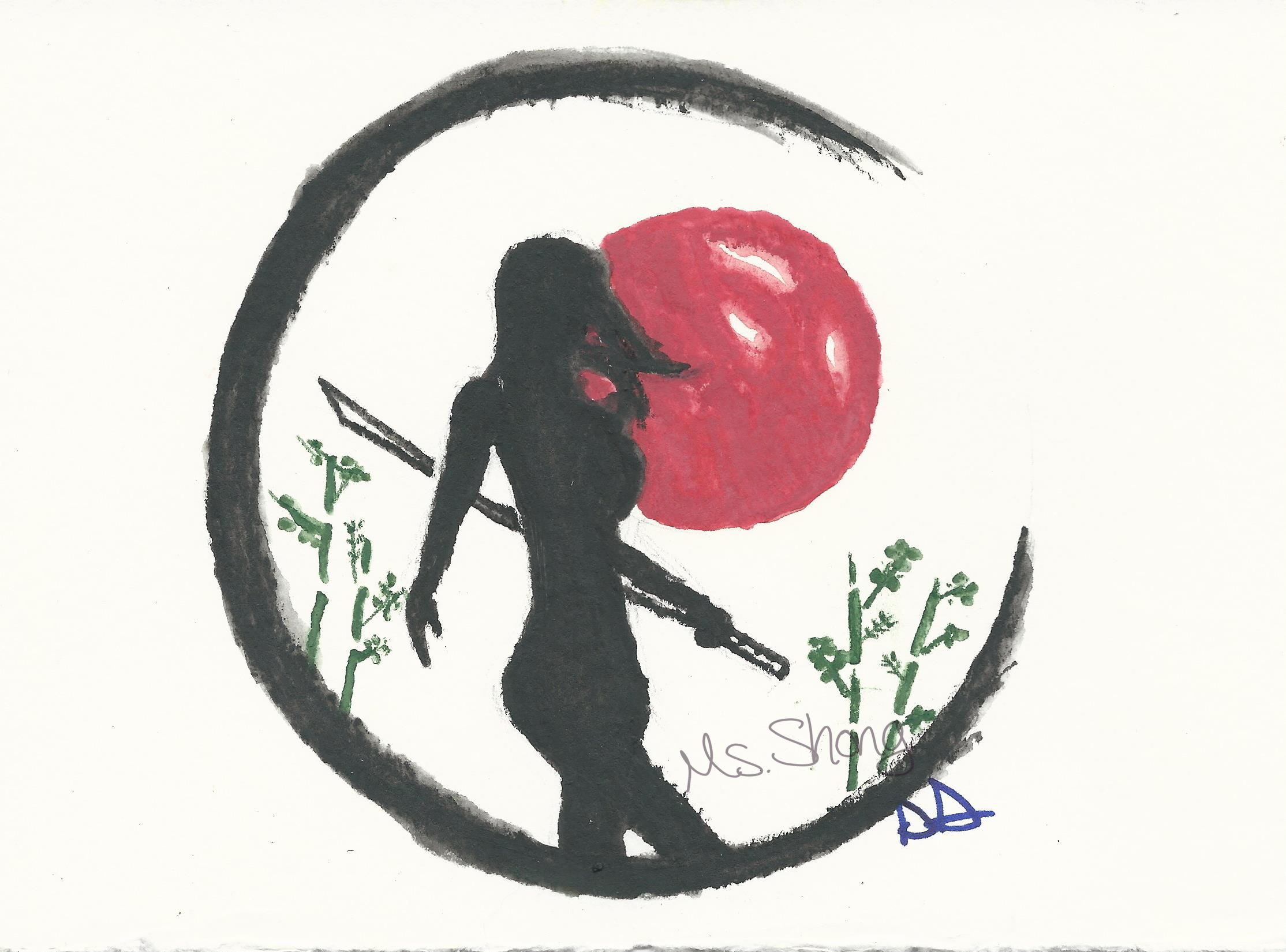
Warrior Women

Always Keep Fighting

Many days it is a constant uphill battle to just do all the things that need doing. Taking care of a home, a special needs child, work and medical appointments leave little room for things like, Yoga or the ability to pee without interruptions.

People say we’re “strong” as if we were given a choice

As an adult I know you can’t just “punch your problems” away… but maybe a few would take a step back if you just had a big enough sword?

Do I have experience with a samurai sword? No. Do I think they’re hella cool? Yes. Yes I do.

My Warrior Women have no time for petty problems, and one answer for the rest.

Am I inspired by Fireflies River Tam? I thinks that’s fairly evident I have a lot of respect for a dancer that can kill you with her mind.

Posted on

Populus trichocarpa

The Black Cottonwood – Salicales Salicaceae Populus trichocarpa if you wanna get picky.

So here’s a sketch I did of some black cottonwood branches in early Spring of this year. It’s a subject I come back to time and again. Leaves are few and far between in early February, so I thought I’d tackle some of the otherwise hidden textures present on the gnarly leftovers from last season. Cottonwood has such character and always has something to offer when I’m itching to sketch and stuck for ideas.

Love em or hate em, I think here in the Lower Mainland of BC, almost everyone has a relationship with the cottonwood. This local tree evokes all kinds of emotion in people, for different reasons, at different times if the year. Every season seems to offer a number of reasons to hate and enjoy this local monster.

Like when it’s allergy season. I count myself as one of the lucky ones who get to enjoy the sweet fragrance of their sticky buds on long walks this time of year.. while others need to remember their daily, 24 hour, fast-acting, non-drowsy antihistamine or suffer the litany of symptoms we all know so well from the seasonal pharma-jingles on the radio, television and such.

Or later in the year when its fluff season. Making it appear to snow in June, the fluffy seeds accumulate into large drifts, becoming knee deep for weeks on end where I live. Every year, big gobs of fuzz inevitably sneak their way into the house and collect in the most hard to reach places. But outside, like in Burnaby’s numerous wetland and repirian habitats, the air can erupt in a beautiful storm of unseasonably flurry-like conditions with the softest of breezes.. and you don’t have to worry, most people are allergic to the pollen not the fluff, so dive in!

Or is it when the winds pickup in early fall. The air starts to cool and the large egg-shaped leaves, almost as wide as they are long and beautifully coloured, litter the paths and sidewalks. That time of year when you get to throw on a light jacket and maybe a scarf for the first time since last year. The breeze starts to blow and you notice how loud the dried leave are rustling high up.. and then you look back down and discover your car’s windshield has been destroyed by a fallen branch as thick as your leg. You know, that branch you park under everyday on the street outside, failing to notice its precarious growth and precise targeting.

Maybe it’s the critters? The Black Cottonwood is the ‘live fast, and die young’ poster child of our local deciduous tree species and do not live very long. However, they grow very quickly and they grow huge. It is one of the few trees big enough to hold bald eagle nests. When branches break off, large open cavities are created high up in the canopy.. perfect nesting sites for any number of owl and woodpecker species, raccoon, squirrel, etc. A sure favourite of numerous species including invertebrates, plants, and eventually fungi and bacteria.

And at ground level and below, the cottonwood’s aggressive and uncontrollable growth can sometimes be costly to home owners. Branches shed regularly and cause damage to roofs and gutters. Roots can destroy sidewalks, driveways, plumbing and drainage. And they are pretty indestructible. In fact the shoots and roots contain so much rooting hormone, even a small piece of fallen branch can root and become a clone. They survive most major weather damage and even a clear-cut at ground level won’t kill this survivor.

Indeed there are plenty of grounds for disappointment and anger in the case against the the Black Cottonwood. But it does play an important role in our local environment, as well as in our homes. In fact, if you happen to be using Scotties toilet paper here in BC, it probably came from cottonwood pulp grown in Chilliwack and made in New Westminister. So there’s that. Maybe not such a pain in the ass after all.

Watercolor paintings were done on De Serres Aquarelle 300 gsm coldpress watercolour paper by Fabriano. I can’t remember the exact colours I used in my ‘soup’ of paint, but they are most definitely Windsor & Newton Professional watercolour and possibly some raw sienna by PWC Premium Extra Fine watercolour. I tried a stylized approach to painting the branch above. I like how it turned out.

For the pencil sketches, I used the same mechanical pencil I use for most of my drawing in the field. I found it in the car under the passenger seat, so who knows where it came from. It’s loaded with .07mm HB lead. I’m drawing in one of my Moleskine 13 x 21cm plain paper Cahier Journal. I absolutely love the paper’s smooth finish.

Couple Extras:

I think that hormone thing is pretty interesting. I have heard there is enough hormone present, that an extract of the shoots can be used as a rooting hormone for all types of cuttings. Shoots are gathered, chopped and soaked in cold water for a day to create the solution.

I also know, from the horrible stains they can leave on your patio and concrete, that a yellow dye can be obtained from the leaf buds. I have made walnut ink before.. I’ll have to try this next year sometime.

It’s also cool to note that on older trees, the bark becomes fissured, gnarly, thick, and very hard.. hard enough to cause sparks when being cut by a chainsaw.

– Aaron

Posted on

Ad Primum Tempus

My Very First Post.. Better Make it a Good One!

Welcome to the Hammer and Pen Artist Collective, a group of artists that create things and share them, here. My name is Aaron Schallie and I’m an illustrator living in Burnaby, a suburb of Vancouver, Canada.

Roughly two years ago, I made a commitment to revisit and improve upon the drawing skills I’ve had since childhood. I had just moved to a new neighbourhood and was presented with a beautiful, brand-new environment to explore, on the edge of a sizable urban forest. What better excuse could I have to be creative and learn.

There were plenty of great subjects to work on and fascinating places to explore. An incredible contrast to living so close to downtown Vancouver, with it’s quick access to beaches and the marine life I was already so familiar with. This ‘neck-of-the-woods’ presented an interesting mountain topography, lots of new critters, and over three dozen trails covering 30+ kilometers. These trails crisscross several distinct watersheds that drain in every direction of the compass. The top of the mountain is crowned with one of Western Canada’s most beautiful architectural jewels, the main campus of Simon Fraser University, designed by Arthur Erickson.

I was surrounded by inspiration.. it was game on.

Since then, I’ve filled more than a dozen moleskine cahiers and sketchbooks and have come to know the ‘mountain’ like the back of my hand. At home, I’ve created a small workspace dedicated to my art projects and supplies, and now have a small functional shop space in the garage, brimming with the potential for much larger projects. I started small, but I’m aiming to create much larger works and possibly explore print making. For now, I try never to leave the house without out something to draw on and I’m keeping it simple.

I mainly use pencil, pen and ink and have started to incorporate some watercolour. I try to draw everyday and give myself regular challenges to improve my skills. Sometimes these challenges lead to more detailed studies of subjects I find in my local environment.

Of course, life’s busy pace and, uh.. a certain global pandemic.. can make allocating time for art difficult. But I try to foster creativity as often as I can and manage to fit it in whenever possible. Most recently I’ve been focused on botanical and biological detail, but I also explore more abstract approaches and sometimes gravitate to subjects in the urban landscape as well.

Over the past couple years, I also remembered to take photos of a lot of my work’s incremental progress, in the hopes I might one day get the chance to share them. This blog is finally that chance. I’m looking forward to sharing some of the steps and challenges in my journey, show off some of my available work, and hopefully inspire others to pickup a pencil and draw. I’ll keep my past works in my Throwback Posts is you’re keen to follow along.

Once we get settled in a bit, I’m looking forward to offering classes, guided walks and plein air sessions. Until then, I hope you enjoy my posts. Let’s get started.

– Aaron.